
You can’t target vaccine ads at young people if you won’t let them get vaccinated.

The COVID-19 vaccine roll out has been a complete mess from the word go.
The prioritising of high-risk groups was always going to put the majority of young people at the back of the line, but rollout stalls have extend the time they have to wait.
Sure, for some the hesitancy to be vaccinated has to do with the Astrazeneca side effects and advice changing, but there was never going to be a smooth rollout without more doses ordered.
Despite the Prime Minister repeatedly stating that this isn't a race, it doesn’t change that we’re ranked dead last in percentage of the population vaccinated in the Organisation for Economic Co-operation and Development (OECD).
Now, with the mounting cases in NSW, a new ad from the federal government has been released to encourage Australians to get tested, stay home and book their vaccinations.
The ad features a young woman, clearly in a lot of pain attached to oxygen and struggling to breathe in a dark hospital room on their own.
It’s reminiscent of the anti-smoking ads we’ve seen in the past, aiming to make us uncomfortable and scared in order to keep us safe.
But airing this ad puts the blame and responsibility on young people when most aren’t even eligible.
Sure, young people can now approach their GP (if they have one) to discuss getting the Astrazeneca vaccine, but with the conflicting advice and not all GPs on board with this, it isn’t really opening the door.
At best this is all just nonsensical, paying to produce and release an advertisement targeted at people who, for the most part, can’t book their jab.
But it’s worse, it essentially says, ‘see this young person wasn’t staying safe and now they can’t breathe and that’s on them’.
There are young people in with COVID-19 in ICU in NSW now, this isn’t some look at what the future will be like if we don’t get vaccinated – it’s what it looks like now.
Making the person in the ad someone who doesn’t look old enough to qualify without meeting another criteria is a choice, a choice made to frame young people as irresponsible risk-takers who aren’t following the recommended precautions.
Never mind the fact that it feels blatantly unethical to launch a scare-tactic campaign amidst a global pandemic that has had significant impacts on the mental health of so many of us.
It isn’t surprising that not being able to get vaccinated has become young people’s fault, this narrative of blaming young people for things they can’t control is well practiced.
But it is an undeniably strange angle to take when young people aren’t opposed to getting the vaccine.
The Daily Aus, an Instagram news channel for young people surveyed their followers and found that 90% of respondents said they would get the vaccine today if one of their choosing was available.
In England, more than 700,000 COVID-19 vaccines were booked on the day their National Health Service vaccination program opened to people aged 18-20.
Young people want to get vaccinated, all they need is the opportunity.

Are young people winners in this year's state budget?

Last week the 2021-22 State Budget was released, and while we have seen young people described as ‘winners’ out of this, there really isn’t much in there for young people at all.
While this year’s budget has big spending in health, infrastructure and education, which will impact young people, spending on the environment, cost of living relief and economic security for young people is missing. It comes during a global pandemic that we know young people will continue to feel the effects of for up to a decade, so we’re disappointed that there are no measures specifically for young people in this COVID-19 context.
The measures that directly relate to young people are:
$2.6m over four years for pilot Stability Post-Care program to support young people up to the age of 21 years leaving care at risk of homelessness
$1.3m over two years for Child Diversion program (Youth Justice) triage and support service for children at risk of being remanded into custody due to lack of accommodation
A two-year extension of payroll tax exemption for apprentices and trainees to encourage employment and training of young people
$4m over four years to establish the position of Commissioner for Aboriginal Children and Young People
$1.2m over two years to establish a significant incident reporting unit in Child Protection which may be useful for children at risk, but it is unclear why a separate unit is required.
The state government has allocated additional funding to child protection and youth justice but here at YACSA, we don’t see that as a win. This much additional money going to child protection and youth justice suggests to us that we’re not doing enough to prevent children and young people entering those systems. Therefore, we would prefer to see more spent on early intervention and prevention services that support young people’s physical and mental health, housing needs, and cost of living.
We’re pleased to see that the role of the Commissioner for Aboriginal Children and Young People will continue. We also kind of welcome payroll tax exemptions for apprentices and trainees, as long as it means more young people can do a traineeship or apprenticeship of their choice and secure a job in that field at the end.
At the end of the day this is just the funding, not that this isn’t important, but in order to make calls of who has ‘won’ and who has ‘lost’ we need to the see the policy it is supporting. We have no real idea of what a lot of this will look like, which is a significant flaw in looking at a budget through the lens of ‘winners and losers’.

Why 'The Smashed Avocado'?

In 2016 columnist for The Australian, Bernard Salt got riled up in an article about young people who go out and order ‘smashed avocado with crumbled feta on five-grain toasted bread at $22 a pop and more’.
According to him, he can afford dropping $20 on lunch because he’s middle aged and has raised his family but young people – they should be eating at home and putting their brunch money toward a house.
This statement made news publications across the world, with the estimates on social media that at that price you would need to sacrifice a weekly brunch for close to 200 years to afford the deposit for a middle of the range home in Sydney.
Young people have been locked out of the property market, but it is much easier to insinuate young people are lazy and wasting their money on brunches rather than looking at the reasons for that like availability, affordability and debt.
We see this kind of thinking about young people everywhere – particularly as they are consistently blamed for the unemployment crisis.
However, apparently having young people globally not only dismantling the whole basis of that argument and clowning you on social media at the time wasn’t enough to stop anyone else from publicly spurting this narrative.
In 2017 Tim Gurner, a luxury property developer and millionaire, made headlines after he told 60 Minutes that the reason why young people couldn’t break into the property market was because they’re spending all their money on ‘smashed avocado for $19 and four coffees at $4 each’.
Because as we all know, saving on $4 coffees is the same as being left a trust fund by a wealthy grandparent like Tim’s.
We’ve all heard these comments, whether they blame avocado toast for us not all jumping toward an unaffordable housing market or, like the Prime Minister, the ‘cafes, dinner parties and wine bars of our inner cities’ to deflect from not being on track to achieve net zero emissions, the problem is obviously those young people and their food and drink spending.
The Smashed Avocado is a YACSA platform designed for young people - want to contribute? Find out how to write your story here.
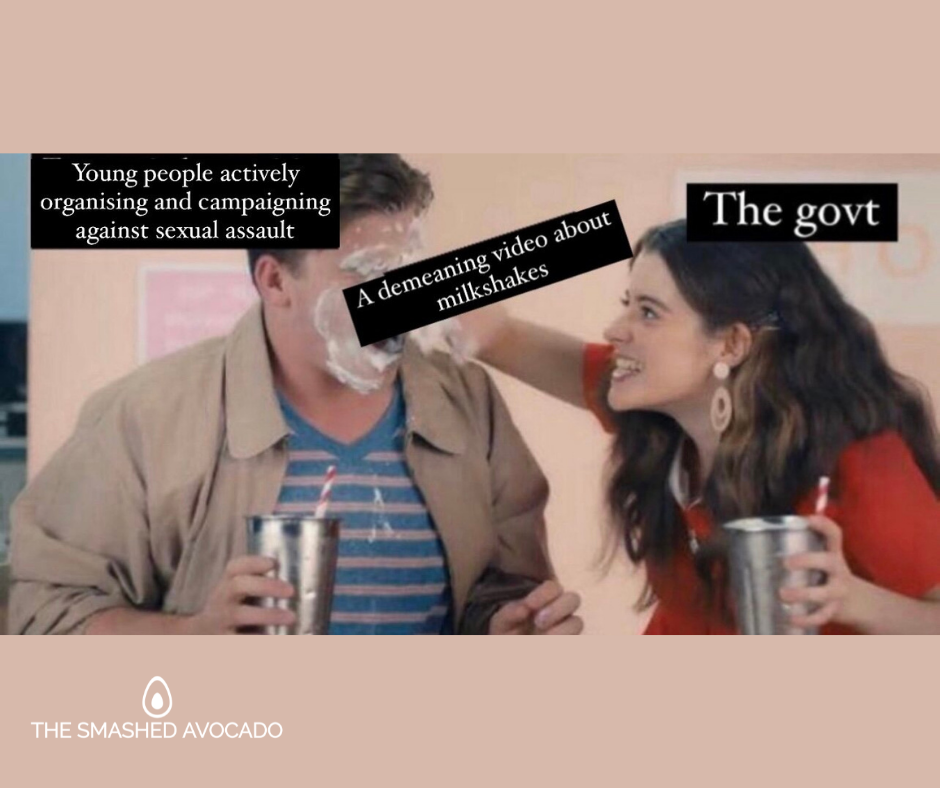
Young people want real consent education, you can keep the milkshakes
In response to calls for consent education in Australian schools after, y’know everything that’s unfolded in politics over the last few months, the federal government have unveiled an almost Four million dollar campaign, ‘The Good Society’.

In response to calls for consent education in Australian schools after, y’know everything that’s unfolded in politics over the last few months, the federal government have unveiled an almost Four million dollar campaign, ‘The Good Society’.
To list the issues with the program would take up far too much of both of our days and there are plenty of great articles doing so, but what underlies almost all of them is the complete lack of understanding of young people.
The disconnect is clear, when young people are demanding real and meaningful change, they are instead presented with a lacklustre program that doesn’t measure up by any standard.
Videos using food metaphors (some of which have now been removed) as if young people couldn’t comprehend conversations around consent, respect and assault without what can only be described as fluff is trivialising and infantilising.
Not only is it a condescending comment on the maturity and understanding of young people by watering down the seriousness of the issue but quite a lot of the site’s content is just confusing.
Some of this is because it is overproduced and avoiding talking directly to a point where you’re guessing at what they meant, but a lot of the content just feels like a worse reproduction of existing material.
The milkshake video is being referred to as a worse and ineffective version of the popular tea consent video, seeming like the purpose of this campaign was to just create something the government could put their name on- rather than something that could be actually useful and beneficial.
It is time to care about women as much as we say we care about women.
This year, International Women’s Day fell in the wake of multiple sexual assault allegations arising from our Nation’s capital. Brittany Higgins coming forward and then the historical allegation against Attorney General Christian Porter, culminated to put a focus on sexual violence against women in Australian media and political sphere.
Content warning- this article contains discussion of sexual violence, rape culture and victim blaming.
If the timing of International Women’s Day in 2021 has highlighted anything it is time to care about women as much as we say we care about women.
This year, International Women’s Day fell in the wake of multiple sexual assault allegations arising from our Nation’s capital. Brittany Higgins coming forward and then the historical allegation against Attorney General Christian Porter, culminated to put a focus on sexual violence against women in Australian media and political sphere.
But the way these young women’s stories have been responded to has been nothing short of disgraceful. We have heard so much about protecting and supporting women, but the actions of our country’s leaders have failed to match up.
Rather than swift action and investigation we have heard how Higgins felt she would no longer have a job if she chose to press charges and seen unwavering and unquestioning support for Porter by his colleagues, despite allegations against him.
If we really cared about women and victims of sexual assault and violence and were actually committed to protecting, believing and supporting them they come forward, why is there a pattern of jumping to protect the men on the other end of these allegations? Why are their jobs and their reputations considered more than that of the women alleging assault?
Alongside this, discussion of these allegations all too often have referred to this as a cultural problem within specific political parties, or a phenomenon within the ‘Canberra bubble’, ignoring the widespread violence against women across the world.
Rape culture isn’t constricted to any one group or place. One in five women in Australia have experienced sexual violence since age 15, so if you haven’t been victim of the types of behaviours alleged, the chances are that at least one person close to you has.
The way that we talk about rape culture matters, the language we use matters, not only to ensure that we are placing the responsibility of these crimes on the perpetrators, but because victims and survivors are always listening.
Phrases like ‘women shouldn’t be able to get themselves into situations where this happens’ reinforces victim blaming, women don’t get themselves into any ‘situations’ they are put there by the perpetrators of this violence. In the same vein, deciding that the responsibility is on victims- to not get drunk, to not wear revealing clothing, to not be attractive or out after dark- insinuates that there is blame placed on you if someone is to assault you.
Victims are never to blame for the violence against them.
Additionally, when we care about these women who have experienced one of the most horrific things that can be done to a person it is not because we have daughters or sisters or mothers, it is because they are people. As put so eloquently by 2021 Australian of the year, Grace Tame in her address to the National Press Club last week:
“It shouldn’t take having children to have a conscience. And actually, on top of that, having children doesn’t guarantee a conscience.”
Victims and survivors of sexual violence are people, people who deserve our respect and our empathy regardless of where they work or what they were wearing, people who deserve so much better than this.
This International Women’s Day felt heavy and uncomfortable. We are angry, angry that these crimes happen and are pushed under the rug repeatedly, angry that people abuse their power to both hurt and dismiss us, angry that so often we are blamed for what others have done to us.
These crimes need our attention, our anger and the continuing power of our collective voices, especially as we have now passed International Women’s Day, to ensure that these women and all other victims are given the justice and support they deserve.
Words by Mallory Bradley
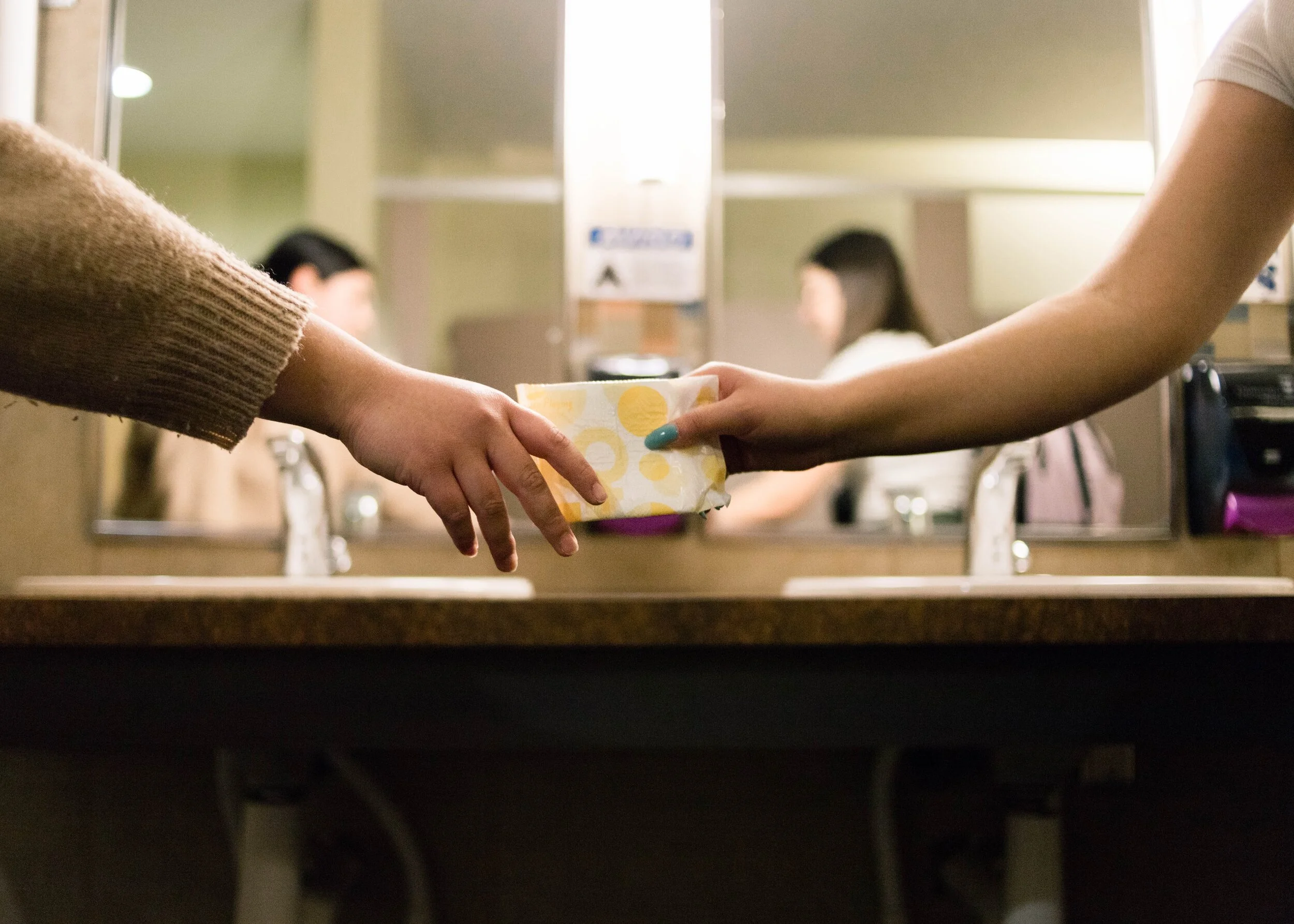
State Government Tackle ‘Period Poverty’ in Schools
Yesterday the state government moved to take action against period poverty by making free pads and tampons available in all South Australian schools, allocating $450,000 worth of funding.
Each public school will receive a grant for sanitary products this school term based on the number of female students they have enrolled.
Yesterday the state government moved to take action against period poverty by making free pads and tampons available in all South Australian schools, allocating $450,000 worth of funding.
Each public school will receive a grant for sanitary products this school term based on the number of female students they have enrolled.
This follows a successful trial here and the Victorian Government granting over $20 million to put sanitary product dispensers in all public schools.
We know that even after the removal of the tampon tax, these products are still expensive but required in some form every month for most people with periods*.
This is why it’s so important to be providing these for young people in schools, not all students are employed, so how can they provide these for themselves if they’re not available at home?
The government funding has come from the perspective of not only wanting to irradicate period poverty but also ensure that no student has to miss out on any part of their education because they are menstruating.
SA Education Minister John Gardner has commented on the importance of meeting the needs of students requiring sanitary products, whether they have limited access or just don’t have any at that moment, that the focus is on making sure learning is the focus in school, not the stress or embarrassment those situations can bring.
The Impact of Periods on School Students in South Australia survey by the Commissioner for Children & Young People last year 26% of respondents reported having missed out on attending school due to not having a period product.
70% of respondents also reported having used something else as a period product such as toilet paper, tissues, socks, and even torn sheets, which encapsulates just how widespread this issue is and how important access to free products is.
*Gender inclusive language such as ‘people who have periods’ or ‘menstruators’ is important to note in this context because we recognise that not all people with periods are women, and not all women have periods. Read more about gender inclusive language from the United Nations here.

Lockdown Update
The state government has implemented a lockdown to stop the spread of COVID-19 in SA. What does that mean?
Update 20/11/20 11:30am:
The Premier has announced that the lockdown will end at midnight Saturday and outdoor exercise with family will be allowed effective immediately.
The state government has implemented a lockdown to stop the spread of COVID-19 in SA. What does that mean? From midnight on the 18th of November, you will have to stay at home for six days.
When can you leave your house?
If you’re an emergency or essential worker (doctors, nurses, paramedics, people who provide disability and homelessness services, carers, etc.)
If you do agricultural work (farming & food production)
To get a COVID-19 test or to see a doctor
To get medical supplies (including prescriptions) or to go to the post office
In an emergency situation or to escape the risk of harm at home.
To go to the supermarket, butcher, fruit & veg for essential supplies but only one person from your household can go to the supermarket once a day.
To look after pets that aren’t at your house or to go to the vet.
For shared parenting or to help someone who needs support or care due to health or disability.
You can use public transport but must wear a mask and take the most direct route.
For a complete list of reasons, click here.
What will be closed?
Takeaway shops
Shops that aren’t supermarkets
Uni’s & TAFE
Schools (unless your parent or caregiver is an essential worker)
Pubs/restaurants/cafes/food courts
Outdoor sport/gyms and team sports
You won’t be allowed to exercise outside or travel within SA. Open inspections and auctions, and weddings and funerals are banned.
What’s staying open?
Critical infrastructure including power, telecommunications, water
Supermarkets for essential food
Bottle shops
Chemists, GP clinics, and hospitals for emergencies
Public transport
Petrol stations
Post Offices and banks
Childcare and schools for essential services workers only
Veterinary services
Essential agriculture services, some factories, some mining and smelting operations and airport and essential freight will keep working.
Need more info?
There’s a Q&A about staying home here – we’ll update this page but it’s a good idea to check out that link regularly because the info will change.
You can also check out SA Health or the state government’s COVID-19 site or call the SA COVID-19 Information Line on 1800 253 787 from 9 am – 5 pm 7 days a week.
COVID-19 Update(d): important resources for young people
There’s a ton of news, updates and announcements being made by all levels of government about COVID-19. Here are eight that can help young people.
There’s a ton of news, updates and announcements being made by government and non-government organisations about COVID-19. Here are six that can help young people.
1. SAPOL COVID-19 Website
The SAPOL COVID-19 website contains COVID-19 related news, current restrictions and directions, important contacts and travel exemption forms.
2. South Australian COVID-19 Website
The South Australian Government’s COVID-19 website provides updated information on COVID-19 restrictions, the requirements and obligations of businesses to keep staff and customers safe, current rates of infection and testing and answers to commonly asked questions.
3. Financial Assistance
The federal government has a range of payments and services during COVID-19 – more info here
And the state government does too, including a SA COVID-19 Cluster Isolation Payment, cost of living concession and an International Student Support Package – more info here
4. Housing
If you’re renting and having trouble maintaining your tenancy, RentRight SA is a free, independent service, helping people maintain their tenancies in private rental, community housing or public housing. The service has COVID-19 related information, but it might change based on government directions or advice. All tenancy agreements are now modified by changes to the Residential Tenancies Act.
5. Homelessness
Homeless Connect SA is a statewide, free telephone service for anyone experiencing homelessness. They can provide short term assistance and connect you with services and supports that can help. They can also put you in touch with Trace-A-Place, a specialist youth homelessness service for young people aged 15-24 years that provide safe spaces for young people to access shower, toilet, hygiene products, sanitary items, food and more.
Call 1800 003 308 – it’s free.
6. The Law and COVID-19
The Legal Services Commission has a range of information, resources and services to assist you with your questions about COVID-19 and the law.
That’s it for now. Stay safe!

It's time to stop blaming young people for the unemployment crisis
To find a solution, we need to understand the problem.
“How we define systemic issues determines how we frame solutions. Public discourse that suggests young people are to blame for their unemployment leads to policies and systems that will not address youth unemployment.”
So here's what happened:
YACSA has been studying and talking about the 'youth unemployment crisis' for years.
Someone contacted YACSA with some interesting questions about youth unemployment.
We thought we'd broadcast our responses, because it's important to understand that young people are not the problem.
Ok. Let's go:
Question 1 - Do we have a youth unemployment issue in SA?
Yes – and it’s not a recent issue – it’s been “urgent” for many years.
Our youth unemployment rate has remained unacceptably high for years with the rate hitting 18.7% in April 2017 and now 16.4% in March 2021 amidst a global pandemic. With JobKeeper ending at the end of March we can expect the unemployment rates to rise significantly when the April figures are released next month on 20 May 2021.
Of similar concern is that the youth unemployment rates in our suburbs compare to the traditionally high youth unemployment rates in regional and rural areas across the country.

“There are simply not enough jobs available for the number of people seeking work.”
This has created an environment not seen before where young people - if they are lucky enough to get a job - will potentially face increasing financial exclusion ranging from being ineligible for housing and car loans to paying for food, shelter, health care and day to day expenses.
Question 3 - What can young people do to address the issue?
Young people are not the problem – the lack of jobs for young people is the problem.
How we define systemic issues determines how we frame solutions. Public discourse that suggests young people are to blame for their unemployment leads to policies and systems that will not address youth unemployment.
If we blame young people for their unemployment, we begin to think that “fixing” young people will solve unemployment. The federal government has been especially good at creating a narrative that suggests young people are unemployed because they’re not trying hard enough and both the Coalition and Labor have used that as a foundation for policies that aim to increase the capacity of young people - but that doesn’t solve youth unemployment. If all the young people in SA that are unemployed increased their capacity, there still wouldn’t be enough jobs for everyone. The issue is the slow rate of economic growth.
“We need to shift the debate, blame, and policy response surrounding youth unemployment from young people to the job market if we want to properly address youth unemployment.”
Question 4 - What should the State Government consider to address the issue?
There is a supply issue in South Australia with 56,800 people looking for work and only 19,300 available jobs. 23,900 of South Australians out of work are young people 15 – 24.
We need to create more jobs and encourage employers to hire young people. There’s a shortage of entry-level positions and on-the-job training, and limited local opportunities. Investment in emerging and growth industries can be effective by creating entry level positions for young people to occupy and progress their careers. That sort of investment would require collaboration of government, private business, universities, community organisations, and consumers.
Incentive programs for employers to hire young people similar to those offered to employers to hire over 50’s would also be helpful.
Young people we’ve consulted have expressed a need for more effective and intensive career development and advice and an increase in flexible learning options to assist young people to remain engaged in education and training that is both relevant and appropriate. We also need to reshape education to emphasise transferable skills – courses designed for specific jobs will be less effective as the job market changes.
We’d like to see employers, schools, TAFE and universities working together to ensure meaningful work experience is available and training and skills development is linked to workforce demand, especially in areas of high youth unemployment.
So there's that. For more information, or if you have any questions, feel free to email us at yacsa@yacsa.com.au, or leave us a comment below.

How COVID-19 is impacting young people
We asked young people to tell us how they’re going with the COVID-19 restrictions and here’s what we heard:
Young people are experiencing increased stress and anxiety about job losses and they’re worried about how they or their family will pay rent and utilities. They are also worried about how they will buy food, medications and other necessities.
Young people are reporting increased feelings of isolation and anxiety as a result of COVID-19 and are concerned about their own and others mental health & wellbeing. They’re worried about vulnerable family members contracting the virus.
Young people are anxious about online education and aren’t getting the support they need to navigate the transition. They’re worried about falling behind in their studies.
Not all young people have access to tech or data and online and phone support/services don’t work for everyone, so some aren’t getting the support they need.
We also asked what they would like to say to decisions makers:
Young people want the government and educational institutions to make sure no-one is left behind or made worse off by COVID-19.
Young people want to know what governments are planning to do to address unemployment and what financial supports and protections will be put in place to ensure they and the wider community avoid increased disadvantage.
We’ve shared this info with the state government and asked what they’re going to do to make sure young people receive the support and services they need during the pandemic and beyond.
We’ll provide updates here about their response but in the meantime, if you haven’t already completed our survey, we’d like to hear from you! Take the survey here.

HOW TO FIND ANSWERS TO YOUR COVID-19 QUESTIONS
Here’s some tips for getting good info.
Here’s some tips for getting good info.
Three weeks ago, we were at school or university, playing sport with our mates, being closer than 1.5 metres from others, and being somewhat cavalier about the length of time we washed our hands.
Oh, how times have changed.
For the last few weeks (although it feels like months) we’ve seen the public, the media and governments throw information at us at a pretty rapid rate. It feels like every day there’s a new thing we can’t do, there’s a new measure in place, or there’s something to be frustrated at.
And because news comes out so fast, it’s pretty hard to keep ahead of what’s going on.
So instead of responding to everything that comes out, we’ve developed this handy post.
Let’s start with where to get good info.
First up, some advice. Anytime you hear or see information about COVID-19 and what you can or can’t do, ask yourself this, is the info from a credible source?
Not sure what’s “credible”. Check out these local resources for latest updates – especially when a lot of the info you might see or hear is about Vic and NSW and the states and territories are responding differently (especially the gatherings info which is stronger in those states). These are the sites we’re getting info from:
SA Health website has info about the number of cases in SA and the latest news from the state government. www.sahealth.sa.gov.au
SA Police (SAPOL) website has all the rules about the emergency declaration and FAQ downloads. The FAQ’s about gatherings is really useful! https://www.police.sa.gov.au/covid-19-information
The federal government has a COVID-19 app – it’s a good source of info about health and income support (Coronavirus supplement payment, Economic Support payment and JobKeeper) and services. Click the link for more info. https://www.health.gov.au/resources/apps-and-tools/coronavirus-australia-app
Need help?
Beyond Blue has been funded by the federal government to create a Coronavirus Mental Wellbeing Support Service – it has telephone support, an online community forum and info, advice and resources. Check it out here. https://coronavirus.beyondblue.org.au/
What’s YACSA up to?
COVID-19 is impacting you and other young people in unique ways – especially education and employment. And rent. And cost of living. And mental health and wellbeing.
Young people should be involved in decisions that affect them – that’s why we have a survey for young people aged 12-25 so we can hear directly from you during the pandemic and share that information with the state government when they’re planning how to respond and support people. (https://www.surveymonkey.com/r/YACSAsurveyyp)
We reckon most young people are doing the right thing during the restrictions, but negative perceptions of young people are still being perpetuated by the media and we’re keen to bust those myths.
We’re also talking to government directly and often.
So, if you’ve got any questions or concerns – complete our survey or chuck your ideas, concerns, experiences or rants in the box below!
Youth Homelessness Matters Day
28,000 young people in Australia are homeless on any given night.
There has been a 26% rise in youth homelessness over the last 10 years.
These numbers are expected to rise due to COVID-19.
Today (April 15 2020) is Youth Homelessness Matters Day (YHMD). The campaign is hosted by the National Youth Coalition for Housing (NYCH) and aims to raise awareness of the impact of homelessness on young people among decision makers and the wider community.


Young people experiencing homelessness have been greatly impacted by the COVID-19 pandemic.
Federal and state governments must take action to support this highly vulnerable group.
It's Time To Raise The Rate
We appeared before the inquiry into Newstart, and we told them that we need to #RaiseTheRate
Let’s unpack why the federal government needs to #RaiseTheRate of Newstart and Youth Allowance.
The best place to start this conversation is with a simple question – why do we have Newstart and Youth Allowance?
The short answer is that they are payments given to people who are looking for work or people who are studying/training full time. Or at least, that’s what they used to be.
Back in the day, it used to be that the government would prop up your income when you lost/left/needed a job. It was a ‘transitional payment’ while you found a new place to work.
It was never really intended to be something that people relied on as an income in and of itself.
That premise has changed in the last couple decades though – especially since the global financial crisis. In 2006 we saw entry level jobs diminish and unemployment rates surge. Where finding employment used to be (relatively) easy, it’s become a really intense struggle for thousands of young people in South Australia.
Today, figures show that there are 19 people applying for every entry level position job. The unemployment rate for young people in SA, as of September 2019, is at 12.7%. There are currently 18,500 people between the age of 15-24 in SA who cannot find work.
We have a generation of people who are finding employment almost impossible. We have a job market that isn’t producing enough jobs for the number of people looking for work.
Which brings us back to Newstart and Youth Allowance. Again, while they USED TO BE transitional payments – a support system for people going from one job to the next – that social context simply doesn’t exist anymore. Instead, we have people who are becoming embedded in unemployment because there are not enough jobs for them. The payment is now, for a lot of young people, the only thing they have to support themselves while they hunt for jobs that don’t exist. Some young people are forced to use it as their only life raft, and it is so inadequate that it isn’t keeping them afloat.
We need to fundamentally rethink what the payment is, the purpose it’s intended to serve, and ultimately the amount it gives to support young people.
Newstart is currently $245 a week, and Youth Allowance is at $227. Here’s how those numbers stack up in relation to the poverty line:


The effect of holding young people below the poverty line is really, really problematic – and we know this from what young people have told us in consultations and surveys.
We know that the low rate of income support is affecting young people’s access to basic, vital things like health, housing, education, nutrition, transport and even their ability to gain meaningful employment. Young people regularly report going without meals, not being able to afford access to appropriate housing, and foregoing medicine, dental care and optometrist services.
When we look at the role Newstart and Youth Allowance are playing in today’s society, the incredible difficulty of finding entry level jobs, and the human cost of holding young people below the poverty line, it becomes pretty clear that we have a broken system that needs fixing.
Young people are being marginalised and excluded because of circumstances beyond their control – they are being subjected to poverty and hardship because there aren’t enough jobs. The rate of Newstart and Youth Allowance must immediately be raised to reflect the current cost of living and to enable recipients to live, work, study or look for employment free from the impacts of poverty.
We need to #RaiseTheRate.
Click these thinks to read more about why we need to stop blaming young people for the unemployment crisis, young people’s experiences with the Jobactive program and our official submission into the federal parliament’s inquiry into the adequacy of Newstart.
If you want to leave a comment and tell us why you think we need to #RaiseTheRate, or if you want to unpack what living on Newstart or Youth Allowance is like, then drop it in the box below!

The State Budget is in, and we’ve broken down how it might affect you.
Find out what the State Budget could mean for young people.
State Budgets normally don’t have much for young people in them, and this one is no different.
Having said that, we’ve gone through it all to find what parts might affect the lives of young people. Scroll down to find out!
IN BRIEF:
What is the budget being praised for?
There’s a lot of money allocated to building things and increasing infrastructure, which will help drive jobs and ‘invigorate the economy’. Also, a lot of the cuts to services that people were worried about didn’t eventuate.
What is the budget being criticised for?
Increases to fees, fines and costs of services.
What can I say to my friends to sound smart if they ask me about the budget?
“There was a major reduction in GST revenue for the State Government – so they were forced into some tough decisions about how to reduce their spending. Still, it’s going to result in increased costs, which is never a good thing’.
HOW WILL THE STATE BUDGET AFFECT YOUNG PEOPLE?
There are six areas where this budget could impact the lives of young people: transport, housing, education, police, child protection and domestic and family violence and victims’ support.
Let’s crack into it.
Transport
What’s happening:
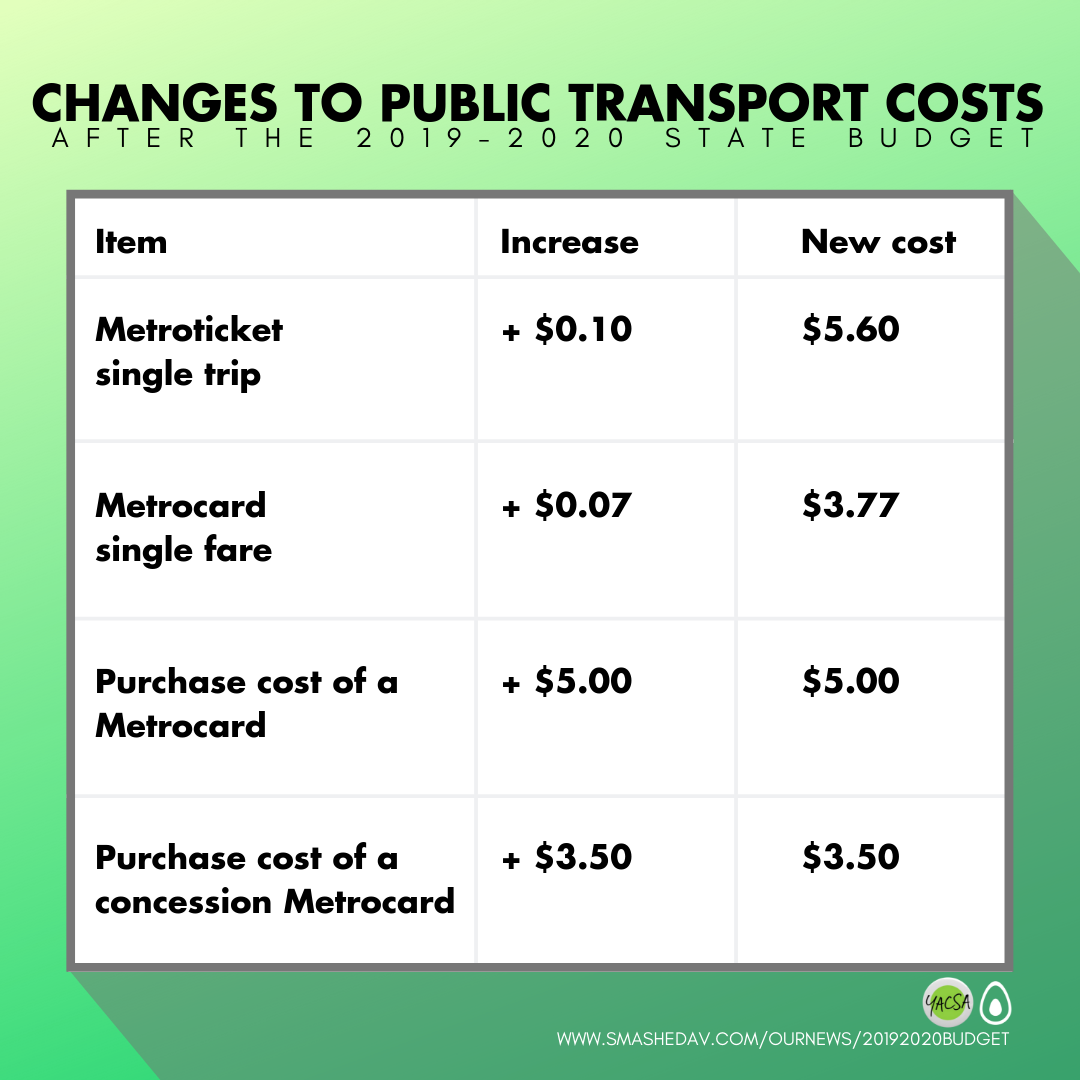
The cost of public transport has gone up (see the graphic above).
The Government has reintroduced the $5.00 purchase cost for a new Metrocard ($3.50 for concession Metrocards).
Motor vehicle registration fees will also rise by $6.00, $13.00 and $19.00 for 4, 5-6, and 7+ cylinder cars respectively.
Driver’s licence renewals will rise by $10 for one year and $20 for 10 years.
Changes to Compulsory Third Party insurance could save individuals around $100 per year on their car registration.
YACSA’s take
Young people consistently tell us that cost prevents them from using public transport or maintaining a car. Any increase in fees has the potential to further reduce young people’s access to transport.
Housing
What’s happening
There’s a $104 million commitment for a housing stimulus package.
$21 million of that is earmarked to maintain/upgrade existing public housing, and to build 90 new homes.
$2 million has also been committed for an Affordable Housing Fund to assist those on low incomes with a deposit to buy their first home.
YACSA’s take
We know that a lot of young people are struggling to afford a place to live. Young people are often not able to afford to rent, much less buy a home. The government needs to commit to increasing stocks of social housing* and to providing programs and services to enable young people to live independently.
*Social housing = Housing owned/managed by the government or community not-for-profit organisations, where rents are generally capped at 30% of a person’s income to ensure it is (relatively) affordable.
Education
What’s happening:
The Government has pledged $185.3 million for upgrades to schools across the state (including regional and rural areas) to help schools cope with projected increases in students and to transition Year 7 into high schools by 2022.
They have invested $80 million into delivering high speed internet to public schools across the state.
TAFE will get an extra $25.5 million.
YACSA’s take:
School upgrades are good, particularly those in regional and rural areas. We also support increased funding to enable TAFE to continue its important role as a pathway to employment and further study for young people.
Police
What’s happening:
Speeding fines will increase between 1.7% to 60% with drivers caught speeding 30km over the posted limit facing fines of up to $1472 (increased from $920.00 in 2018-19).
Fines for using a mobile phone while driving will similarly see a 59.9% increase rising from $334.00 to $534.00 in 2019-20.
YACSA’s take:
First off, fines are avoidable and in a perfect world no one would receive them because everyone would behave. Nevertheless, young people on low incomes will be hardest hit by any increases to fines and other expiation notices.
Child Protection
What’s happening:
There’s $26.9 million over the next three years to address the surge in children and young people entering out-of-home care.
As a prevention and early intervention measure, Government has committed $568,000 next financial year on a new ‘family group conference’ pilot and the funding for that is set to rise to $1.1 million in 2020-2021.
Government has pledged $3 million to trial an ‘intensive family support program’ for families that are at risk of having their children enter the child protection system.
YACSA’s take:
YACSA welcomes increased spending to ensure children and young people are protected and safe once they enter the child protection system.
Government needs to demonstrate a greater financial commitment to strengthening families to prevent children and young people entering the child protection system in the first place.
Domestic and Family Violence and Victims’ Support
What happening:
Government has committed an additional $383,000 to the Domestic Violence Disclosure Scheme trial in 2019-2020 after strong results were recorded by the service in 2018-2019.
However, cuts were also announced including a $150,000 per year cut to the Women’s Domestic Violence Court Assistance Service and a $1.2 million per year cut to the Victim Support Service.
YACSA’s take
With the gravity of reported (and potentially unreported) incidences of domestic and family violence in the community, YACSA urges Government to fully support both prevention and early intervention measures and the service response to the victims of domestic and family violence.
Want to know more?
Click the links to check out our:
2019-2020 Budget Snapshot - YACSA’s full budget snapshot that breaks down the key elements of the budget.
2018 State Election Scorecards - where you can check out the promises Goverment made to young people about issues young people are passionate about in the lead up to last year’s State Election.
What's next?
Young people told us their top issues heading into the election were climate change, mental health, education, employment and discrimination + inequality. Find out what the government promised in relation to these key areas.
Unpacking what the Government promised in relation to the issues that matter most to young people.
The election has wrapped up and is in the books.
Scott Morrison and the Liberal Party are in charge for the next three years. There’s a lot (A LOT) of articles circulating around the internet about what happened, why it happened, and who deserves credit/blame.
But, as the dust continues to settle and the noise calms down, what we’re left with is a returning government with policies that will impact the issues young people are passionate about.
In the lead up to the election, we asked young people what their top issues were.

Using those responses, and cross referencing them with the Liberal Party’s plan, let’s unpack what to expect, what to get excited about, and what’s got our concerns raised.
For a more indepth dive into what the Government committed to in their 2019-20 Federal Budget, check out our snapshot.
And, you can find a full list of the Government’s policies by clicking this link.
Climate Change
The Government’s Promise:
A $2 billion Climate Solutions Fund to help farmers, small businesses and Indigenous communities reduce emissions, lower energy costs and improve the natural environment.
Snowy 2.0 to create more hydro-electricity and more storage.
A National Electric Vehicle Strategy to transition to new tech.
Initiatives that focus on making households more efficient, making communities greener, and investment in the Great Barrier Reef Foundation.
YACSA’s Take:
The Climate Solutions Fund has come under criticism for being enough of an investment and using rewards instead of punishments to decrease emissions. Here’s Olivier Yates, former CEO of the Clean Energy Finance Corporation (who ran as an independent in the election) discussing why the policy may not be all that great:
The $2 billion Climate Solutions Fund “is completely inadequate,” former CEO of the Clean Energy Finance Corporation @_Oliver_Yates, who is now an independent candidate for Kooyong, tells @PatsKarvelas on #afternoonbriefing #auspol pic.twitter.com/63jZe4sfzn
— ABC News (@abcnews) February 25, 2019
Notably, there is no plan to #StopAdani or to stop drilling the Bight, which were core issues brought forward by young people in the School Strike for Climate.
For a more detailed analysis of the Liberal Party environment policy, check out what the Australian Conservation Foundation had to say.
Mental Health and Wellbeing
The Government’s Promise:
Investing $503.1mil into a Youth Mental Health and Suicide Plan. Most of the energy and money in that plan will go to strengthening headspace, and increasing to 145 centres around Australia.
There’s a plan to focus on Indigenous suicide prevention.
YACSA’s Take:
Increasing funding for mental health services is a really positive step forward. The concern moving forward is that there’s currently a gap between ‘prevention and early intervention’ and ‘crisis support’ called the ‘missing middle’. A piece by Triple J Hack explored the missing middle, why there are service gaps, and what it’s like for young people in Adelaide who are struggling to get the mental health support they need.
YACSA has also advocated for years that access and quality of mental health services in rural and remote areas needs to improve pretty drastically. You can read what we have to say on the issue by clicking this link:
So - the idea is good and the funding is welcome. Listening to people who are experiencing the mental health system and continuing to adapt services to suit their needs is the vital next step.
Education
We’re going to split this into ‘schools’ and ‘tertiary education’.
Schools
The Government’s Promise:
A commitment to the National Schools Chaplaincy program, with a new focus on anti-bullying. The program will put chaplains (people affiliated with a faith or religion) in schools to ‘provide pastoral care, run programs like breakfast clubs and coordinate volunteer activities’.
A plan to ‘make Catholic or independent schools more accessible’.
A policy to commit to a full implementation of NAPLAN.
YACSA’s Take:
For us, any policy that mandatorily ties student well-being and care to religious institutions raises our concerns for what it will mean for LGBTIQ+ young people.
Tertiary Education
The Government’s Promise:
A commitment to continue the program aimed at making university more accessible, particularly for people in regional and remote areas.
Adding a ‘public interest test’ to all publicly funded research.
Use incentive payments for employers and apprentices to create 80,000 apprenticeship positions.
YACSA’s Take:
We’re fans of making education accessible for everyone, especially young people in regional and rural communities who are often the ones who miss out.
There are criticisms of the public interest test policy that you can read here.
Employment
We will split this topic into ‘employment’ and ‘unemployment’.
Employment
The Government’s Promise:
Create 10 Industry Training hubs in areas of high youth unemployment
Expand the PaTH (prepare – Trial – Hire) program.
The Government has also predicted that measures to boost the economy will create 1.25 million jobs over the next 5 years.
YACSA’s Take:
Brandon, one of our young members wrote a piece on the Smashed Avocado about the issues with PaTH, and you can read it by clicking here.
You can also read our story that explores how blaming young people, or creating policies that look to ‘fix’ young people, in an employment context are flawed and disingenuous. When there’s 22,500 young people trying to find work and only 9,500 jobs available, it’s time to stop blaming young people for the unemployment crisis.
In a nutshell, the Government will need to ensure that the placements, pathways and programs lead to meaningful, non-exploitative, safe and lead to real work opportunities and a living wage for these policies to be effective.
Unemployment
The Government’s Promise:
A commitment to ‘reinvigorate’ the Work for the Dole program.
A policy that will require those on welfare who are affected by drug and alcohol to undertake available treatment. There is also a plan to trial drug testing for people on Newstart and Youth Allowance, however the trial locations are not in South Australia.
The Government has indicated, without committing to anything in particular, that it intends to continue to roll out the ‘Cashless Welfare Card’ that restricts what those on welfare are able to purchase.
YACSA’s Take:
So, basically the Government’s approach is going to be to continue to add conditions to welfare as a means of disincentivising reliance on Newstart and Youth Allowance – and to force people to work in jobs that don’t exist.
Emily, a young member, wrote a story about her experiences with Work for the Dole, and how the program can have adverse effects, particularly for young people.
Discrimination and Inequality
The Government’s Promise:
The only policy we could find on the election platform page in this space was a commitment to women. The Liberal party committed to ‘Supporting Australian Women’ by focussing on jobs, child care, flexible parental leave, safety, health and sport.
YACSA’s Take:
We looked for policies that specifically aimed to help, support or promote Aboriginal people, gender and sexually diverse people, people of different cultural backgrounds and young people but couldn’t find anything.
We’re also coming off the back of a projected surplus that was significantly bolstered by an ‘underspend’ in funds for the National Disability Insurance Scheme (NDIS) – an underspend that disability advocates argued is due to problems accessing services, and not from a lack of demand.
Bonus!!
In a fun little plot twist, we are getting a Youth Minister.
Ministers are members of parliament who are given special areas to focus on. Going into the election, the Labor party had promised a Minister for Young Australians but there was no promise from the Liberal party.
However, it has been announced that the Government is establishing a Minister for Youth and Sport, and it will be Tasmania Senator Richard Colbeck. We haven’t had a Minister for Youth since the Abbott Government scrapped it 6 years ago.
So. Good news. Hopefully.
You can check out all the Ministers in the Government’s new ‘Cabinet’ here.
OK, but what next?
Whatever your emotion is regarding the election result – anger, joy, sadness, rage, whatever – the challenge is to not let it become apathy. Don’t not care. Politics can be frustrating, but democracy is about more than elections. Look what happened with the marriage equality survey! Mid-election cycle, the people forced the hand of the Government by relentlessly letting their views and values be known. Whatever you’re passionate about, whatever change you want to see, whatever change you want to drive, go and do it. Spark passion in people who agree with you, be kind to those who don’t, and see what happens. Don’t wait for them to ‘give you a voice’. You’ve always had one. Go make it deafening. Drive change.
Election Hub
When young people vote, cool things happen. So we’ve got everything you could ever want to know about voting in one convenient place.
Elections are tricky business. The rules aren't always clear, knowing what you need to know isn't easy, and there's always one just around the corner.
Elections are also the best time to drive change.
So we've put everything you could possibly need to know about voting in one convenient hub.
Check out the links, explore around, and if you have any other questions let us know in the Rant Space below!
Language is powerful. So let's get it right.
The School Strike for Climate is massive, and awesome. Let’s make sure the language used to describe it is correct.
Note: to avoid confusion, please be aware that this article was published after the School Strike for Climate in March 2019.
The School Strike for Climate was massive!
Not only did we see young people stand up for an issue they are passionate about, but we also saw a lot of commentary about young people, their political contributions, and how different sections of society see them.
On one hand, you had journalists and politicians saying that young people don’t deserve to be heard, that their ideas aren’t mature enough, and that they should go back to school. They called the young people ‘kids’, ‘children’, ‘adolescents’ and ‘teenagers’, which had the effect of infantilising and trivialising what the young people were doing.
And on the other hand you had people doing damage the other way. There were people in the media and in parliament gushing over how ‘our kids’ were ‘putting their Pokemon Go to the side’ and doing something meaningful. They talked about how ‘our future leaders’ were showing that they ‘will one day be a force to be reckoned with’. Well, that’s nice, but why are they future leaders? Because it looks a lot like they are leaders right now. They’re citizens, and this is what citizens, regardless of their age, do when they feel frustrated with the people who are meant to represent them.


We’re fascinated by the language surrounding the strikes because it says a lot about how society views the political and democratic contributions of young people.
It shows how threatened or uncomfortable some segments of society are with the fact that these citizens are more connected and informed than any previous generation, and they’re using those tools to band together to stand up for things they’re passionate about.
Whether it’s March For Our Lives, the Don’t Kill Live Music rallies, being a vocal part of the Marriage Equality movement or leading the School Strike for Climate - This isn’t about ‘giving young people a voice’. They’ve always had a voice. This is about those in power finally being forced to listen.
And, because they can’t combat the righteousness of the claims the young people are making, the only move those in power have is to trivialise the fact that it’s young people delivering the message – so it’s time we call that out.
If you see language that describes young people as anything other than complete and competent citizens doing things complete and competent citizens do, then call it out. Challenge people to be better.
Language is powerful.
So let’s make sure we get the language right. Let’s make sure we elevate the views of young people.
Don’t just “listen to the voice of young people” – amplify it, make it deafening and support them as they drive change.
5 Reasons Why Sniffer Dogs In Schools Won't Work
Sniffer dogs are set to be deployed in schools in an attempt to combat drug use among students. There’s only problem with the plan… and it’s that nearly every element of the plan is flawed.
Sniffer dogs are set to be deployed in schools in an attempt to combat drug use among students.
The approach was part of the current Government’s 2018 election platform and the protocols to activate the policy have now been signed off.
There’s only problem with the plan… and it’s that nearly every element of the plan is flawed.
Walk with us, as we unpack 5 reasons why sniffer dogs in schools is problematic.
1. Sniffer dogs don’t actually work
This is a big one. Sniffer dogs aren’t accurate. They’re adorable. But not accurate.
According to the South Australian Government’s own data: In 2017-18 police dogs or drug detection systems indicated a person was carrying drugs on 2715 occasions, but drugs were only found on 485 of the people searched.
So to translate that – the success rate of sniffer dogs last year was 17.8%, meaning 82.2% were erroneously identified.
In an article on the ABC, criminal lawyer Rachael Shaw was quoted as saying, ‘… the fact that there seems to be a high figure of error in the statistics even more so reinforces my view that it's an unnecessary and clearly inaccurate way of detecting drugs in our schools’.
Peta Malins, a lecturer in justice and legal studies at RMIT University, compiled the literature and found that the presence of sniffer dogs, rather than acting as a deterrent, can lead people in possession of illicit drugs to act in an unsafe manner to avoid detection, including:
Consuming drugs quickly if sniffer dogs are present
Using the drugs in advance
Stashing drugs in internal cavities
So this is an inaccurate solution.
2. Drug use is already low, and declining
This is a serious policy decision with far-reaching impacts that you would expect would be based upon sound evidence.
However, recent illicit drug use statistics do not support the notion of an increase in the use of illicit drugs that would warrant the use of sniffer dogs in schools.
The 2016 National Drug Strategy Household Survey (NDSHS) demonstrated that there were overall and significant declines in the use of meth/amphetamines (from 2.1% to 1.4%), hallucinogens (from 1.3% to 1.0%) and synthetic cannabis (from 1.2% to 0.3%) between 2013 and 2016. The use of illicit drugs amongst young people 14-19 has also decreased since 2001 with reported use falling from 18% in 2001 to 9% in 2016.
So this is an inaccurate solution to a problem that’s already declining.
3. It’s goes against the UN Convention on the Rights of the Child
At YACSA, we’re pretty big fans of human rights. We’re particularly fans of the UN Convention on the Rights of the Child and we think governments should protect and promote the rights of young people.
The rights afforded to young people under the United Nations Convention on the Rights of the Child are clear that children and young people should not be subjected to arbitrary interference of their privacy (Article 16). The ‘Sniffer Dogs in Schools Policy’ subjects children and young people to arbitrary interference in their privacy. This policy suggests that young people should forgo their rights to assist government to undertake a war against a ’[drug] scourge in our schools’.
And the word arbitrary here is important, because there are already existing laws that give the police power to search in schools if there is ‘suspicion of drug activity’. So the new policy goes beyond that by giving the police powers to search even when there are no grounds for suspicion. It’s arbitrary (random).
So this is an inaccurate solution to a problem that’s already declining that goes against the human rights of children and young people.
4. They’re not targeting all schools – just public schools
The current plan by the government focusses on allowing sniffer dogs into public schools. While there is provision for private schools to ‘opt in’, the policy expressly targets public school students. Being subject to arbitrary police searches because you do not attend a private school problematic, offensive and discriminatory.
So this is a discriminatory policy that poses an inaccurate solution to a problem that’s already declining, and goes against the human rights of children and young people.
5. What should they do instead?
The policy will not stop young people using drugs.
A focus on punitive measures at the expense of evidence-based prevention and early intervention responses appears counterproductive and runs the risk of humiliation, demonisation and introducing young people unnecessarily to the youth justice system.
Government should must instead invest in prevention and early intervention services and programs whose primary aim is to strengthen families and communities while addressing the personal, familial and societal factors that lead young people to use illicit and licit drugs.
So *takes a deep breath* this is a discriminatory policy that poses an inaccurate solution to a problem that’s already declining, and goes against the human rights of children and young people, and we know it won’t work and that there are better solutions available.
So… why is this happening…?

17 Decisions, Events and Ideas That Impacted Young People In 2018
2018 is in the books. Let’s dive in to some of the key decisions that affected the lives of young people in SA.
2018 is in the books.
We’re going to break down the biggest stories on the Smashed Avocado of 2018,
But before we do we want to say thanks.
To all the young people who have been driving change with us, through surveys, events, sharing our stuff, writing to us, writing for us, and being members - THANK YOU.
You're the experts in your own lives. You know more than anyone else what's important to you and what is affecting your life. Sharing that expertise with us is what allows us to do what we do.
We’ve reached thousands, literally thousands, of people through this site - so thanks for being on the journey with us.
We really appreciate it.
Thank you.
You’ve been awesome.
Now. Let’s look back and what was in 2018 (so much happened that we’ve broken it down into categories).
Democracy and Politics
1. The State Election

2. What The Actual Heck Happened During #LibSpill?!


4. Don’t Let Yourself Not Vote In Council Elections

Young people driving change
5. Florida Students


Young people telling their story
7. Emily: Here’s What Jobactive Is Really Like

8. Caitlin: From Education To Unemployment

9. Emily: “Let Me Tell You About Work For The Dole”
Emily shared her experience with Work for the Dole, and what she thinks about the program.

10. Matt: 5 Struggles Of Regional Life for Young People

11. Riley: Sustainability - What’s It To You?

Unpacking the big stuff
12. Stop Blaming Young People For The Unemployment Crisis

13. Young People Are Changing The Game When It Comes To Democracy

14. Sentencing Young People As Adults Won’t Make Us Safer


16. What You Need To Know About “The Religious Freedoms And Schools” Debate

Ongoing
17. LGBTIQ+ Consultation

Thanks again for the year.
We’ll see you all in 2019 - where there will be a Federal Election and plenty more to unpack with you.
Until then, we’re going to leave you with this video!
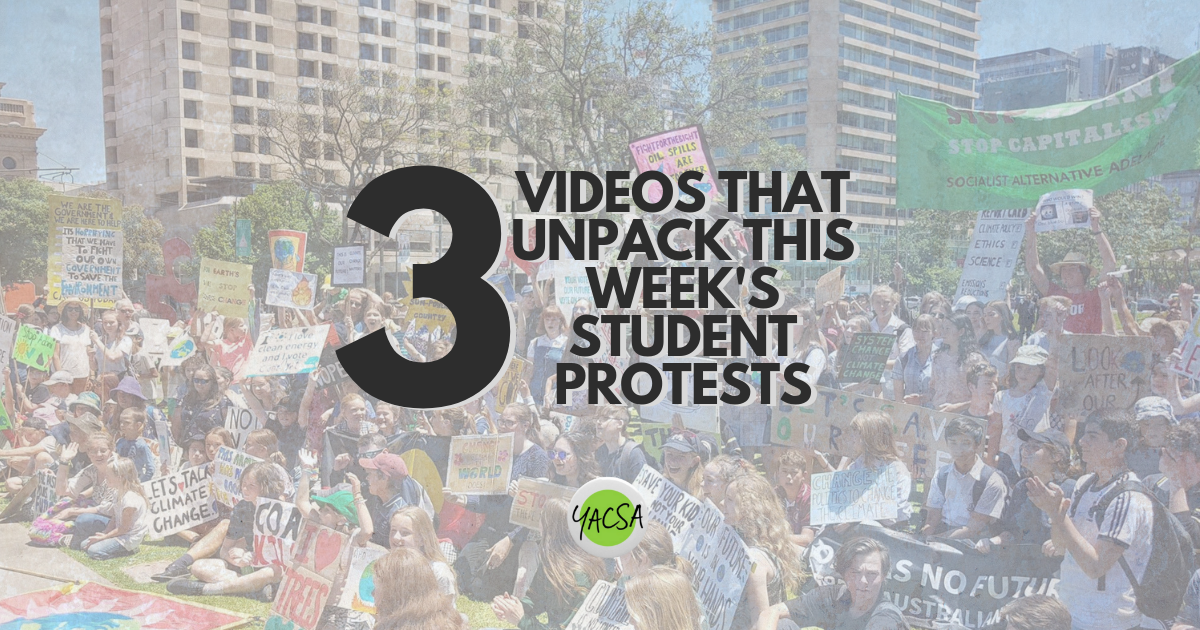
3 videos that unpack this week's student protests
Students are protesting and people are protesting their protests. Find out more.
1. Students are protesting for Climate Change around the country this week
Young people are driving change, and leading a movement, in regards to an issue they’re passionate about.
You can find out about the protests here: https://www.schoolstrike4climate.com/
2. The Prime Minister told the students to be ‘less activist’
Here’s a video:
3. And of course, here’s some satire
Mark Humphries of the ABC made this:
*Note: language warning
A message from the Coalition to students planning to protest.pic.twitter.com/YgLlyXrIyM
— Mark Humphries (@markhumphries) November 29, 2018
4. YACSA’s take
We've written quite a bit about how good things happen when young people engage with politics.
As citizens and community stakeholders, young people have a right to be involved in the decisions that affect them and to be able to discuss their concerns and issues with decision-makers.
This is not about ‘giving young people a voice’ - young people have their own voice, and they are using it to force those in power to listen.
This is what it looks like when young people drive change.