
3 videos that unpack this week's student protests
Students are protesting and people are protesting their protests. Find out more.
1. Students are protesting for Climate Change around the country this week
Young people are driving change, and leading a movement, in regards to an issue they’re passionate about.
You can find out about the protests here: https://www.schoolstrike4climate.com/
2. The Prime Minister told the students to be ‘less activist’
Here’s a video:
3. And of course, here’s some satire
Mark Humphries of the ABC made this:
*Note: language warning
A message from the Coalition to students planning to protest.pic.twitter.com/YgLlyXrIyM
— Mark Humphries (@markhumphries) November 29, 2018
4. YACSA’s take
We've written quite a bit about how good things happen when young people engage with politics.
As citizens and community stakeholders, young people have a right to be involved in the decisions that affect them and to be able to discuss their concerns and issues with decision-makers.
This is not about ‘giving young people a voice’ - young people have their own voice, and they are using it to force those in power to listen.
This is what it looks like when young people drive change.


Read More


Don’t let yourself not vote this council election.
Everything you need to know to make sure you vote this council election
Here’s our answer to all the reasons you might not want to vote.
1. Council elections are boring.
Yea but what if instead of calling it ‘council elections’ we called it ‘a chance to elevate someone who reflects your views into a position of power’? Because check this out:
Don’t think about Councils. Don’t think about politics.
Think about the issues.
The things you’re passionate about.
The causes that make you angry, excited, frustrated, empowered.
The things you want to see changed in the world around you.
Take them, and use elections like this as a chance to drive change.
Ask your candidates questions, and demand they give you answers.
Some people get voted in on fewer than 100 votes.
Some candidates kind of bank on the fact that young people won’t vote.
If you get your mates together and really push for a candidate that reflects your views, you can change what happens next.
Do it. Vote.

2. But I don’t know what council I’m in, or who I’m voting for?
We got you covered.
Click this link, type in your address, and you’ll get your council and the people you’ll be able to vote for.

3. OK but I don’t know when I have to do what?
Aren’t you lucky we made this:

4. But I don’t know how to vote in a council election?
Put a ‘1’ in the box of your favourite candidate.
Put a ‘2’ in the box of your second favourite candidate.
Keep going until you’ve numbered as many boxes as there are vacancies (the ballot will tell you how many vacancies there are)
Put the ballot in the envelope they give you.
Seal it.
Fill in the details.
Put it all in the OTHER, BIGGER envelope.
Seal that envelope.
Chuck it into a mailbox (you don’t need to stamp it).
Do a happy dance or cook a democracy sausage or tell a friend to vote.

Example of how not to do it.
4. But I don’t even know what councils do…?
Pretty simply, it’s council’s job to make sure your area suits your needs.
Think about all the public space in your area.
The roads, bikeways, footpaths and street lighting? They’re council’s job.
The parks, trees, ovals, and sports facilities? They’re council’s job.
The public libraries, community centres and cultural centres? They’re council’s job.
Festivals, cultural celebrations and major events? They’re council’s job.
Your wheelie bins, and the bins in the streets? They’re council’s job.
At a basic level, councils take care of the space where you work, live and play, and much much more.
So when you vote, think about electing someone who you think it going to make sure your community reflects your needs.

That’s it.
Remember. Don’t let yourself not vote this council election.

What you need to know about the 'religious freedoms and schools' debate
Find out what’s happening, how we got here, and YACSA’s take.
What’s happening:
There’s a new push aimed towards allowing schools to discriminate against LGBTIQ+ students, on the grounds of religious freedoms.

(Leaked Ruddock Report segment)
How did we get here:
We had the Same Sex Marriage Survey in November last year.
Australia voted YES.
The Prime Minister at the time, Turnbull, established a review into religious freedom as a sort of olive branch to the ‘NO’ side of the parliament.
The review was headed by conservative ex-politician and former Attorney General, Phillip Ruddock.
It was finished in May 2018.
It was kept under wraps for quite a while.
Bits of it were leaked recently, including recommendations to allow religious schools to discriminate against LGBTIQ+ students.
UPDATE:Now the Federal Parliament is considering passing a new law - called The Sex Discrimination (Amendment (Removing Discrimination Against Students) Bill 2018 - that would strengthen the protections for LGBTIQ+ students.
The proposed law is good - but we don’t think it goes far enough.
So basically, we’re at a point where the rights of LGBTIQ+ students (and teachers) are a contentious political debate.
YACSA’s take

Read more
Here’s an article from May about what people thought of the Ruddock report, from Buzzfeed.
Here’s an article about the complexities afoot, from the Conversation.
What do you think?
Let us know here:

We read the SA budget so you didn't have to.
We break down what you need to know about the issues you care about

OVERALL, THIS BUDGET IS QUITE BORING.
There. We said it. We admit it.
For young people, especially two weeks removed from the Federal Government’s circus, it’s hard to turn our minds to governments doing real work. But here we are.
The budget does, however, give us a window into how the Government plans to address a range of issues that affect the lives of young people. So let’s unpack what we’ve got ahead of us.
SUPER BRIEF GUIDE TO THE BUDGET.
What is the budget being praised for?
It’s cutting costs. There are some taxes that have been reduced, and some services being cut.
What is the budget being criticised for?
Some of the things being cut are TAFE campuses, bus routes (potentially and probably), and jobs.
What can I say to my friends to sound smart if they ask me about the budget?
This is a ‘wait and see’ budget. This Government will be judged on how they replace the benefits of the services they’ve cut in the name of ‘efficiencies’, and how they make sure young people who are missing out are supported.
WHAT DOES THIS BUDGET MEAN FOR THE THINGS I AM PASSIONATE ABOUT?
Education
- The Laptop for Schools program will be ceased.
- The Safe Schools program will be axed.
- The Government will fund a $15 million attendance, drugs and anti-bullying initiative in schools.
- New schools will be built in Munno Para, Aldinga and Whyalla.
- 7 TAFE campuses are being closed (Tea Tree Gully, Port Adelaide, Urrbrae, Parafield, Wudinna, Roxby Downs and Coober Pedy).
YACSA’s take:
The laptop program and regional TAFE campuses help ensure that all young people have access to meaningful participation in their education, and cutting them will have a negative effect on some young people.
Just because TAFE campuses aren’t efficient to run doesn’t necessarily mean they are not worthwhile. Travel costs are expensive and prohibitive, so closing education facilities for people in regional areas will only further limit their access to meaningful skills training. How the Government replaces these opportunities will be important to watch.
Employment
- The Government is getting rid of payroll tax for small businesses. This will eliminate the payroll tax of 3,200 small businesses.
- The Future Jobs Fund has been scrapped.
YACSA’s take:
There’s not much in the budget surrounding employment, which is kind of frustrating given that there are 17,900 young people looking for work in South Australia.
The big ticket here is the payroll tax cut. We’ve talked a lot recently about how employment measures that target young people, and not the failing job market, will never work. So it is heartening to see the Government seek to address employment by, theoretically, helping small businesses grow. Whether or not this measure will lead to more jobs being created remains to be seen.
Cost of living
- The Emergency Services Levy (a tax) will be cut and could save households around $145 over the next 12 months (as per the ABC).
YACSA’s take:
When young people raised the cost of living as a major issue in the lead up to the State Election, they mentioned things like rent, food, utilities, petrol, transport and licensing. Cuts to the ESL will save some young people some money, but will do little to address the costs that are impacting the lives of young people.
Note: There are also measures to help 40,000 SA households get solar batteries. While it’s uncertain whether this will give young people immediately relief from their cost of living burdens, it’s still a pretty cool measure – especially if you’re passionate about renewable energy.
Transport
- The Government are going to put mobile phone charging stations at public transport stations.
- The Government is also going to conduct a review into public transport, looking into “low patronised services”, and “optimising timetables” (Read: some bus lines will be cut).
YACSA’s take:
We’re concerned about language that talks about ‘low patronised services’ and ‘optimising timetables’. If low density or outer-metro areas are targeted in any cut down, transport is going to become even more problematic for young people in those areas. Optimising timetables could affect the frequency of services late at night, negatively impacting the accessibility and safety for young people who need to travel late at night due to shift work, university study or social activities.
Mental Health
- The Government will establish a Borderline Personality Disorder service.
- The Government will establish a Paediatric Eating Disorder Service.
- The Government has committed additional funds for suicide prevention services.
YACSA’s take:
These measures are good, and are exactly what the Government promised before the State Election. Before the election, the Government also promised a state-wide Mental health Services Plan which is not in the budget. Considering the core mental health related issues young people had before the election were access to services – especially in regional and rural areas – that plan is going to be crucial moving forward.
Other cool stuff
- The Government will extend support to carers of young people up to 21 years of age (it was previously up to 18 years of age).
- The Government will fund an additional 40 domestic and family violence crisis beds.
- DHS screening will be free for volunteers.
YACSA’s take:
All three of these measures are massive steps forward that will help people in really important ways.

Read our story on why the narrative around youth unemployment needs to change

What the actual heck happened during #LibSpill?!
The 10 questions young people asked us during #LibSpill answered
Hi all, and congratulations for surviving #LibSpill week.
The votes have been cast, the drama has unfolded, and we have a new Prime Minister: Scott Morrison.
We asked young people to send in their questions through the events, and the key questions we got were:
- Where does everything sit right now?
- How did we get here, and what caused this?
- I didn't vote for this, how is this allowed to happen?
- Is there a limit to how many times they can change Prime Minister?
- Why was Parliament 'adjourned'? Why didn't they have to do their job?
- What would they normally be doing this week?
- Can I have some memes?
- Who is Peter Dutton?
- Who is Scott Morrison?
- When do we get to vote next?
Let's go!
1. Where does everything sit right now?
- Scott Morrison is the Prime Minister
- Josh Frydenberg is the Deputy Liberal Leader
- Dutton came second in the vote, but will keep being a parliamentarian. It has been announced that he will go back to Home Affairs under the new Government
- Julie Bishop came third and has stepped down from the Ministry (she will remain an MP)
- Turnbull has resigned as Prime Minister, and has indicated he will quit parliament 'imminently'
Here's the full list of the new Cabinet:
2. How did we get here and what caused this?
In terms of this week, Buzzfeed Oz Pol has an amazing timeline to see everything that happened this week:
3. Australia didn't vote for Dutton/Morrison, how is this allowed to happen?
Welcome to the Westminster system!!!
Australia didn’t vote for Turnbull either - we don’t actually vote for the Prime Minister. We vote for party members, and those party members decide who their party leader is.
So it’s technically not undemocratic.
Just… next election, if you wanted to you could ask your local member if they promise they will stand by their leader if that's something that is important to you.
4. Is there a limit to how many times they can change Prime Minister?
Nope.
Like we mentioned above, the Prime Minister is just the party leader. And the parties can change their party leader as often as they like.
In 2013 when Rudd took over from Gillard, the Labor party did introduce new rules to make it much harder for a leadership spill to occur. Rudd has recently called on the Liberal party to change their rules as well.
5. Why was Parliament 'adjourned'? Why didn't they have to do their job?
Great question.
On Wednesday, the day before the Liberal Party had their vote for party leader, nearly everyone in the Liberal Party resigned from their portfolios, That meant they had no-one to represent the government in the Lower House.
And then things got preeeetty weird...:
So... yea. The government shut down the Lower House.
The Senate, though, went ahead.
Fun times.
6. What would they normally be doing this week?
This is the last sitting week before September 10. To their credit, they still managed to pass laws about Image Based Abuse and some taxation measures.
But... many people pointed out that issues like homelessness, the environment, poverty and employment - which are pretty important/stressful issues for people - were going unattended.
7. Can I have some memes?
Yea sure.


8. Who is Peter Dutton?
Peter Dutton was a few votes away from becoming our newest Prime Minister and was a key figure in what happened during #LibSpill but not many people know who he is.
A few young people asked us who he is and what he stands for, and we found this little video (warning - explicit language):
Note: It has been confirmed that Peter Dutton, having lost the spill, will return to the Home Affairs portfolio.
9. Who is Scott Morrison
10. When do we get to vote next

Some time within the next 12 months there will be a Federal Election.
Gear up.
Get ready.


What do you know about Image Based Abuse?
We recently went to a training session on Image Based Abuse (sometimes incorrectly referred to as 'Revenge Porn') run by YWCA Adelaide and Legal Services Commission of SA, and the info below is based on what we learnt...
We recently went to a training session on Image Based Abuse run by YWCA Adelaide and Legal Services Commission of SA, and the info below is based on what we learnt...
1. It's not called revenge porn
The term is Imaged Based Abuse (IBA)

Why don't we use the term “revenge porn”?
Because it implies sharing the image is done as an act of revenge. It implies that the person deserves retaliation. No one deserves this, no matter what. It’s not your fault if someone shares your image without your consent.
2. Image Based Abuse can be more broad than pornographic images
It also includes humiliating and degrading filming, such as acts of violence like school yard fights and hazing videos where there is no consent to being filmed.
It also includes invasive images.
An invasive image is one in which the person is shown in a place other than a public place and engaged in a private act (including a sexual act), a state of undress showing their genitals, anal region, or female breasts covered by underwear or bare (this doesn’t include images that are generally considered decent such as innocent photos of babies sent to family or friends).
3. If someone shares an invasive image of you without your consent - it can be an offence.
4. You can't legally consent to an invasive image being shared if you are 16 years or younger.
This means that even if the young person in the invasive image is willing for the image to be shared, it can be an offence.
5. Threatening to share an invasive image can be an offence as well.
If someone THREATENS to distribute an invasive image without your consent, and wants to make you fear that the threat will be carried out (or doesn't care if you're likely to be afraid of that) - it can be an offence.
So a THREAT to share an invasive image is also treated seriously.
6. We’re often unclear about what to do if an invasive image has been shared.
Here are some people, services and organisations that can help:
- Report to the eSafety Commissioner.
Any Australian victim of image-based abuse can make a report to the Office of the eSafety Commissioner. They will work with you and do our very best to help get the image or video removed.
https://www.esafety.gov.au/
- Legal Advice Line
Free, confidential legal advice on the telephone about most legal issues.
Available 9am – 4:30pm, Monday- Friday
Ph. 1300 366 424
- Legal Chat
Type-chat to a legal advisor for personal assistance with legal information. Available during business hours.
Legal Services Commission
- The Line
https://www.theline.org.au/young-people-and-technology
7. Being safe online is relatively easy to learn.
We can have some control who we let into own online space.
(Note: This is not intended to be a segment telling you what to do, or what you have to do. That's not what we're about. This is just us letting you know there are things you can do, and about giving you ideas you can try)
Our online space should be comfortable and not a cause of anxiety, so it’s important to be selective and assertive about who we invite into it.
When a friend/ follow request pops up, it might be helpful to ask yourself
- Would I choose to spend time with this person IRL?
- What value are they going to bring to my world?
And, make sure you regularly review your privacy settings.
There are a heap of sites out there that take you through a step by step process of how update your privacy settings, it’s only one google search away….
8. It’s not your fault if someone shares your image without your consent
It. Is. Not. Your. Fault.

That's it
If you'd like to know more, check out some of the online resources below!
The eSafety Commissioner is responsible for promoting the online safety for all Australians by:
- a complaints service for young Australians who experience serious cyberbullying
- identifying and removing illegal online content
- tackling image-based abuse.
The Line, Dealing with online abuse: https://www.theline.org.au/dealing-with-online-abuse
LSCSA Factsheet, Porn & Sexual Photos and film: https://lsc.sa.gov.au/resources/Porn_Sexual_Photos_and_Films_Young_People.pdf
And if you have any thoughts about this, let us know in the Rant Space below :)

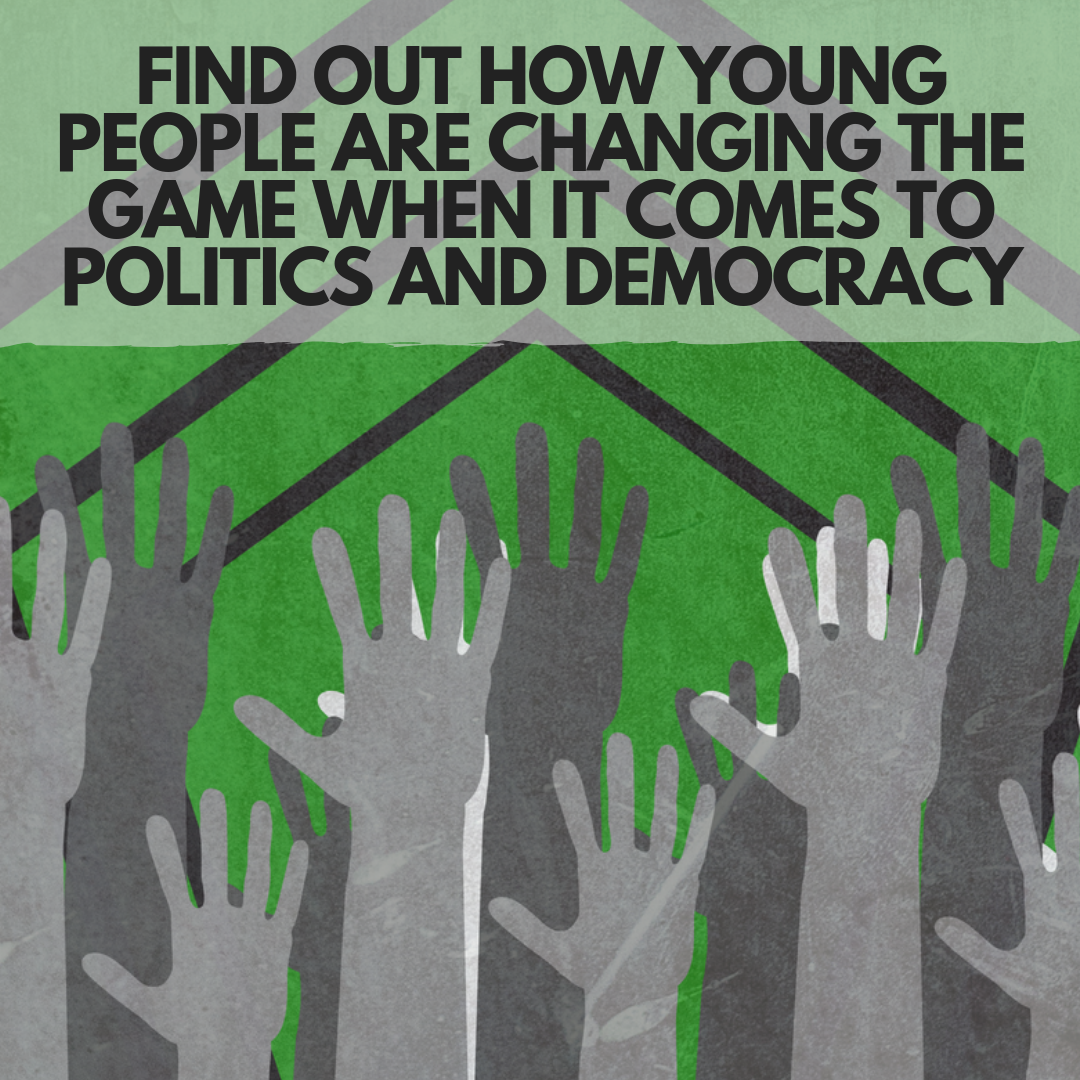
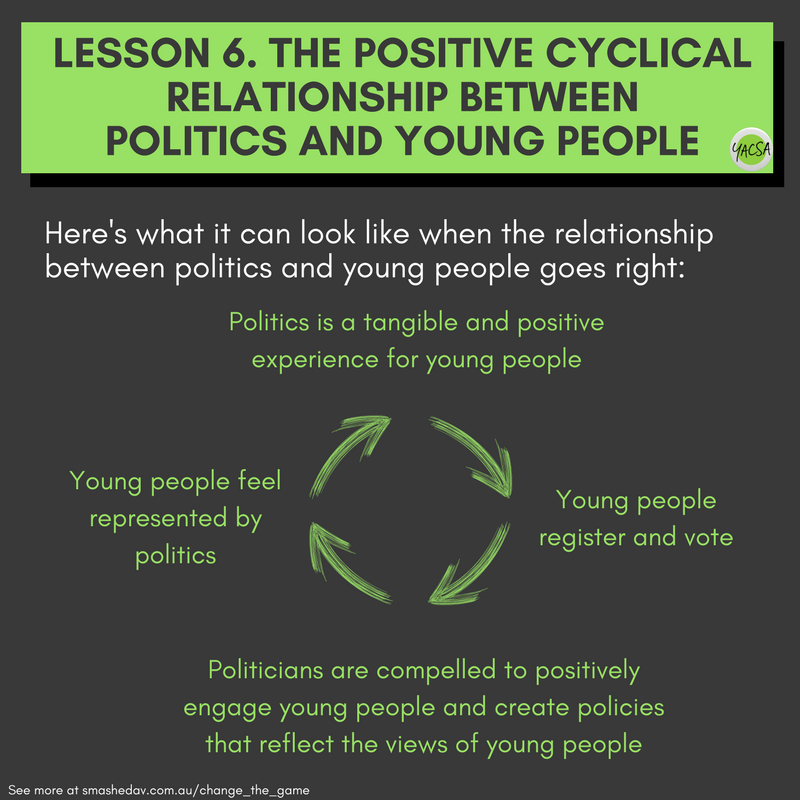
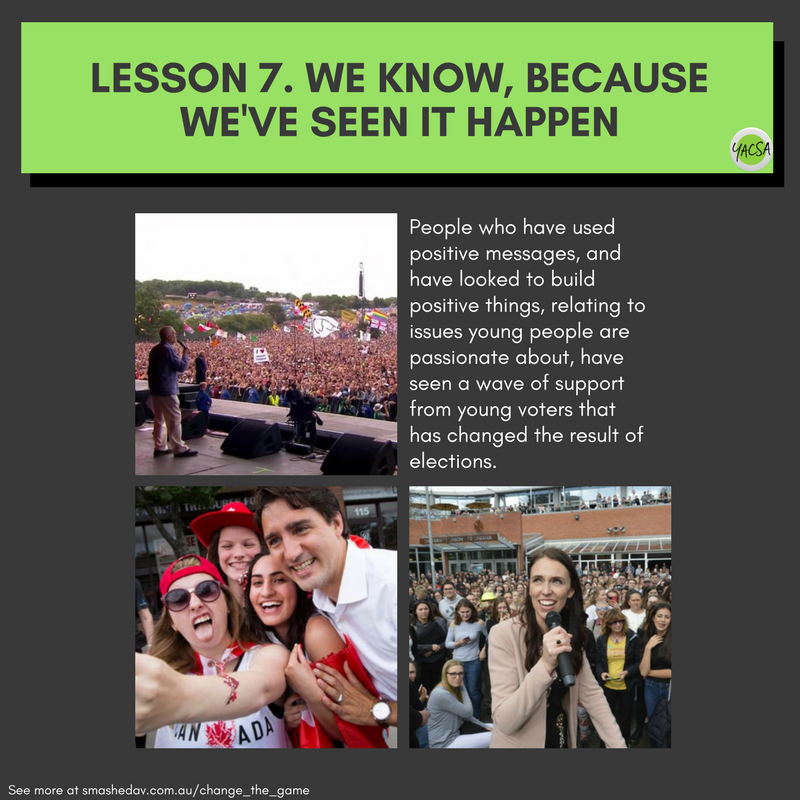
Young people are changing the game when it comes to democracy
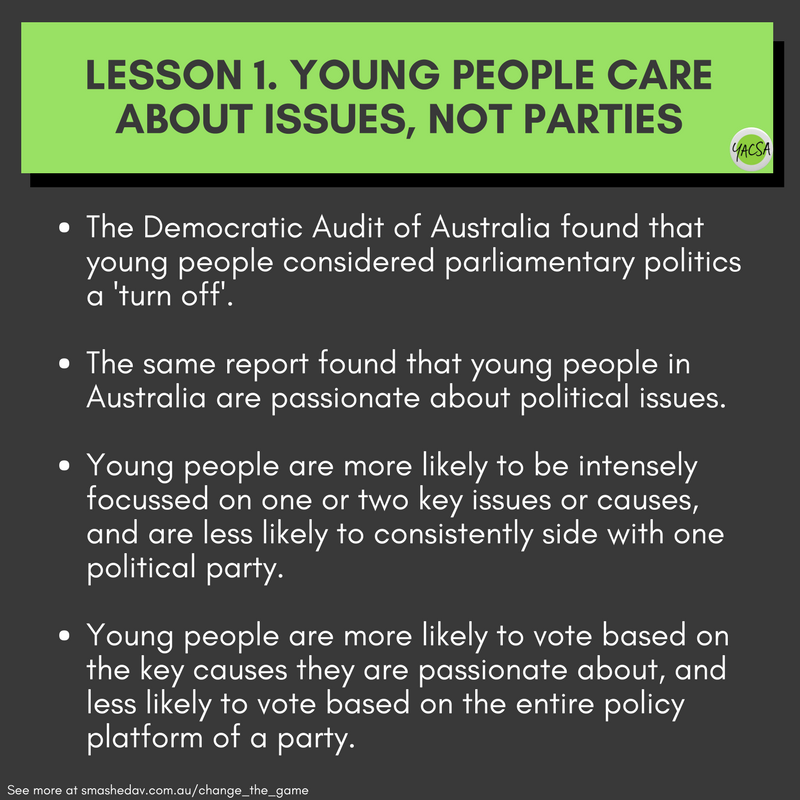
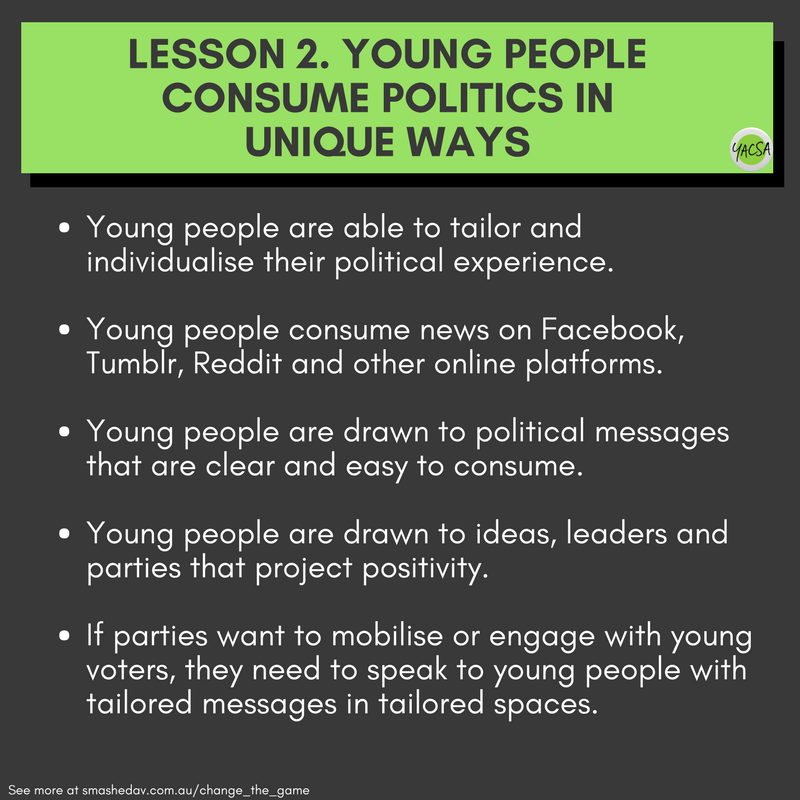
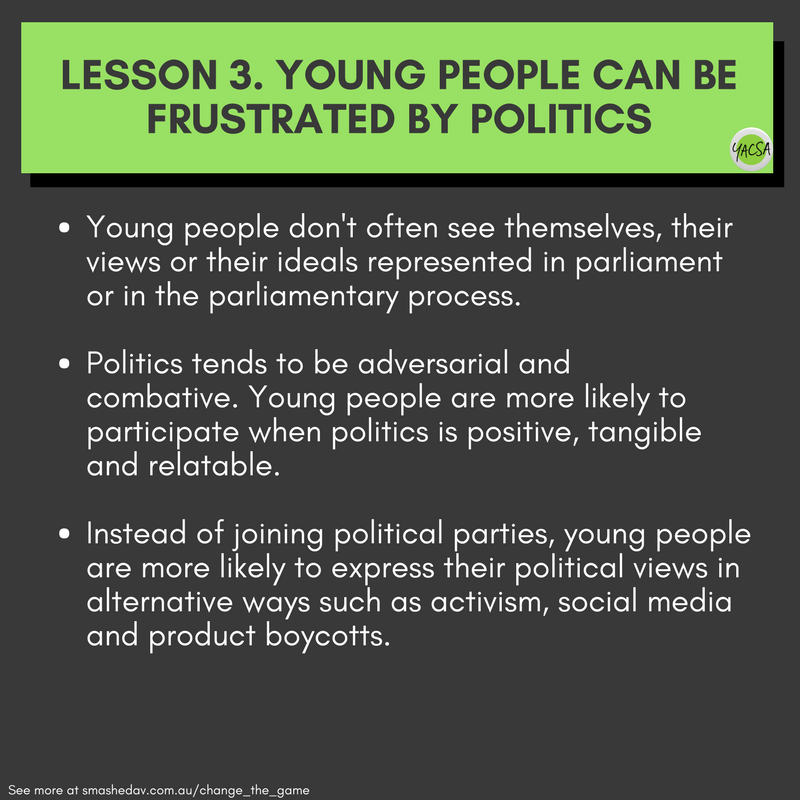
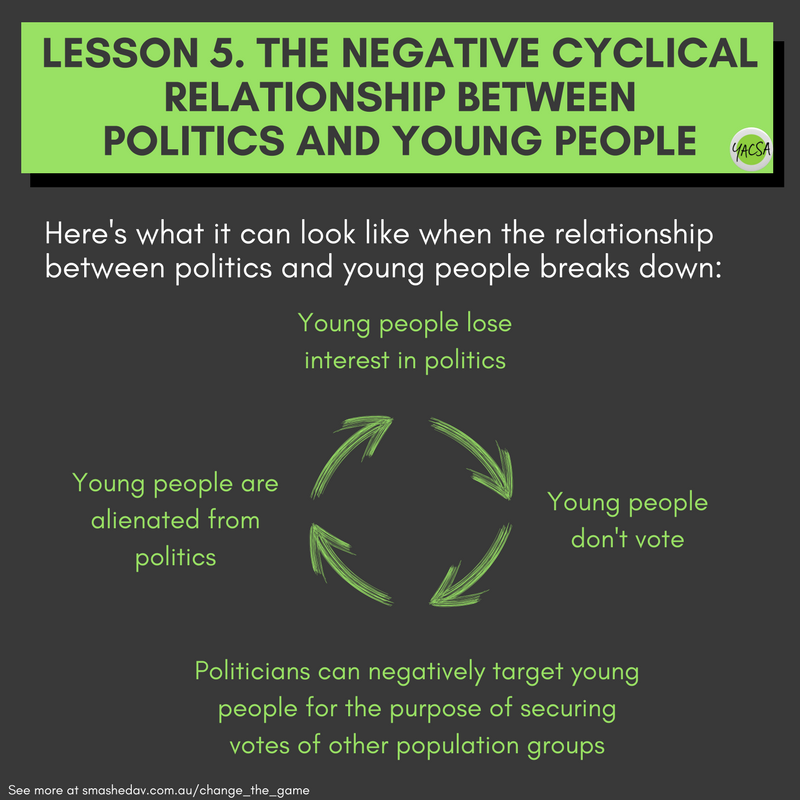
Young people care about issues. Young people find politics a 'turn off'. How will that impact elections moving forward, and what happens when young people use their political force to demand change during elections? Dive in and find out.
The following content is based on the fantastic work and research conducted by Faith Blake and Jeff Tomlian.
We've been committed to finding out how young people are reshaping politics in SA, Australia, and around the world.
The lessons from the research are clear: Young people consume politics and participate in democracy in unique ways. When those ways are understood, amazing things can happen.
Check it out:


Why sentencing young offenders as adults won't make us safer
Sentencing young people as adults won't make us safer, and can lead to increased re-offending. Find out why it's time decision makers started listening to the evidence.

“THE STATE GOVERNMENT’S LATEST ‘TOUGH ON CRIME’ MEASURE TARGETING YOUNG OFFENDERS IS LIKELY TO BE COUNTERPRODUCTIVE.”
A lot has been said about young offenders in the media lately – including a seemingly endless number of reports about systemic abuse within youth justice facilities around the country – and that has reignited debate about what should happen to young people who commit crimes.
The question of what penalties should apply to young people who have committed a serious offence is complex and often divisive but you’ll get no argument from me that some offences warrant jail time – especially if that crime results in the death or injury of a member of the public. Young people are subject to the law and should be held to account for their actions.
There are however, separate laws and systems for young people and adults and there’s a good reason for that, namely that children and young people are not considered as mature as adults.
Psychologists tell us that children and young people’s brains are still developing; that changes during puberty lead young people in search of excitement and reward; and that the functions of impulse control, planning ahead and risk avoidance have not fully matured.
The South Australian Young Offenders Act (1993) recognises the developmental stage of young offenders and makes provision for the “…care, correction and guidance necessary for their development into responsible and useful members of the community and the proper realisation of their potential”. In other words, the main focus of youth justice is rehabilitation.
“DESPITE A DOWNWARD TREND IN YOUTH OFFENDING IN SOUTH AUSTRALIA SINCE 2008, THE STATE GOVERNMENT IS PROPOSING AN AMENDMENT TO THE ACT THAT WILL SEE CHILDREN AND YOUNG PEOPLE SENTENCED AS ADULTS IN CERTAIN CIRCUMSTANCES.”
Attorney-General, John Rau has said that current criminal sentencing laws are inadequate when dealing with serious repeat offenders and don’t reflect community expectations. He also said that repeat offenders have “lost the right” to benefit from the rehabilitative focus of the Act.
Sentencing children and young people as adults will likely mean longer sentences but research suggests longer sentences have little to no effect on the rate of re-offending and in fact, can increase the likelihood of re-offending. Take away the rehabilitative function of the Act and it’s difficult to see how the proposed changes will reduce offending and lead to safer communities.
A range of contributing factors impact offending including family violence, abuse and neglect, substance abuse, mental health issues, and socioeconomic disadvantage. One in five children and young people in secure care are under the Guardianship of the Minister and almost half (47.9%) of children and young people in secure care identify as Aboriginal and Torres Strait Islander.
“THE STATISTICS ARE CONCERNING AND DEMONSTRATE THE SOCIAL AND SYSTEMIC DRIVERS OF OFFENDING ARE CLEARLY NOT BEING ADDRESSED.”
It is a fact that most offending committed by young people is transitory, with the vast majority of young people maturing out of criminal behaviour. Arrest, detention, and imprisonment of children and young people should be used only as a measure of last resort and for the shortest appropriate period of time. And with over half of young people released from sentenced detention returning to another period of sentenced supervision, it would appear that those who re-offend have not received the care and guidance necessary to become productive members of society.
Focussing on the imprisonment of children and young people at the expense of policy and programs that seek to enable young people to avoid the youth justice system altogether would appear to be counterproductive.
Investing in prevention and early intervention services and programs whose primary aim is to strengthen families and communities while also addressing mental health, drug and alcohol use, family violence and dysfunction and the experience of disadvantage, has a much greater chance of reducing offending behaviour in the longer term.
Provision of evidence-informed diversionary and rehabilitation programs both within and external to detention are much more likely to result in less crimes being committed, less victims and are a much better use of taxpayer dollars.
In other words...
“THE BEST WAY TO DEAL WITH CRIME IS TO PREVENT IT.”

The Florida students are teaching us all a lesson
After a mass shooting in an American school, students responded politically and passionately - and there's lessons we can learn.
After a mass shooting in an American school, students responded politically and passionately - and there's lessons we can learn.
Watch this.
And this.
And check this out.
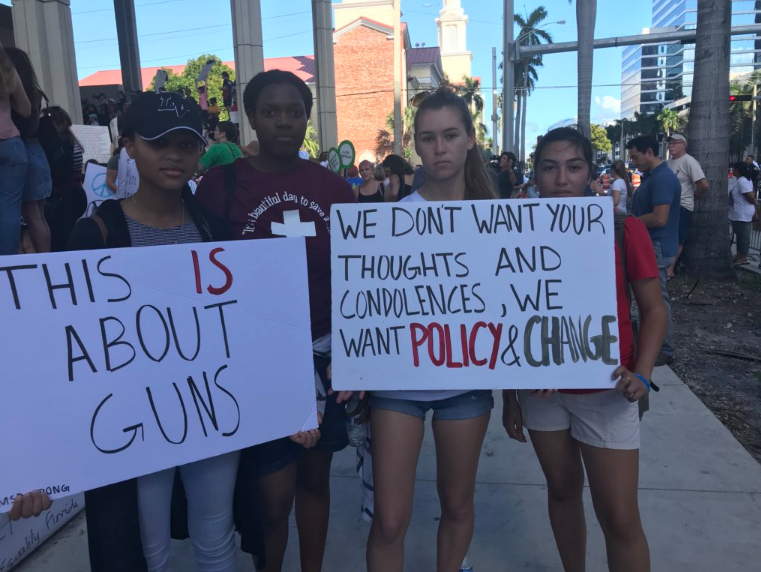
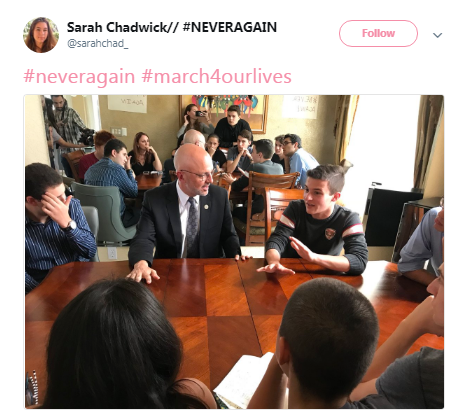
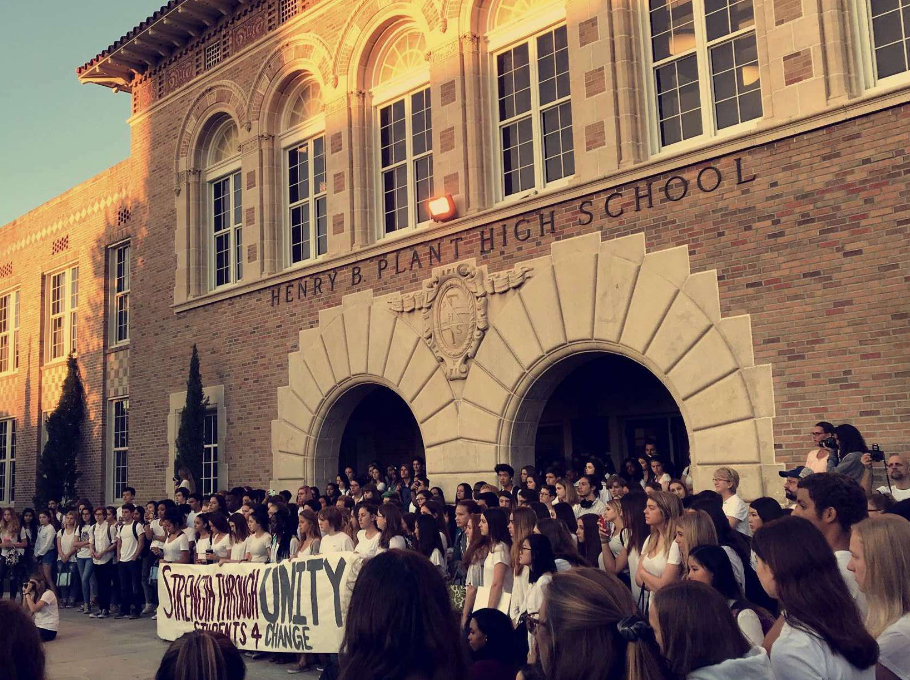
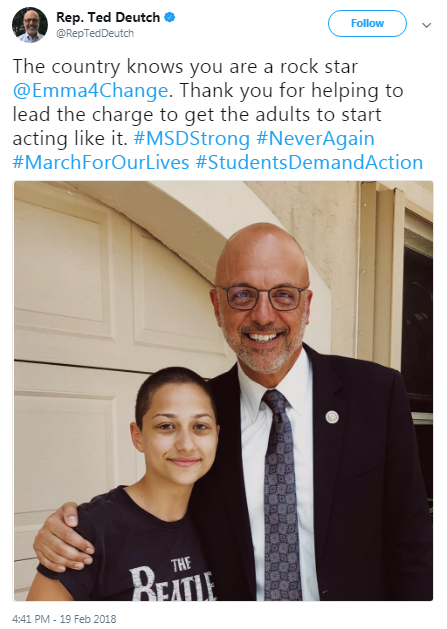
The fallout from Florida has shown that young people are leaders. Not leaders of tomorrow, not future leaders, not leaders in training. They’re leaders now.
Young people’s participation in public discussions is often discredited, dismissed or denied simply because they are young. The stake young people have in society, and their abilities, views and opinions are often undermined by language that sentimentalises, pathologises or infantilises young people.
But these young people have smashed through that barrier.
These young people are driving change. They’re using activism. They’re organising town hall discussions. They’re organising marches. They have clear, concise calls to action. They’re rallying communities and citizens together for a cause.
... So what does this say about the role adults can play in supporting young people?
This is what it should look like.
Instead of adults acting as the gatekeeper or conduit to the thoughts, ideas and political expression of young people, the adults are stepping to the side and supporting young people as young people take centre stage and deliver their ideas first hand.
Adults are not ‘giving them a voice’, or ‘providing a platform’ – the young people are stepping up, using their voice, and creating their own platform.
You can call the speeches of Emma Gonzalez and Cameron Kasky presidential, amazing, passionate… anything you want. But don’t be surprised.
This is what it looks like when young people drive change.

40 reasons why it's time Adelaide got our skate park back (and why it's a win-win for everyone)
Find out how the rest of the world is benefiting from investing in skate parks.
THE PRELUDE
YACSA is the peak body for young people in SA. We do not have a position on skating, riding or skate parks in South Australia. However we do have a position on young people and their use and need of public spaces and on young people being involved in decisions that affect their lives.
We also aim to help young people learn about the tools and techniques of advocacy.
So when a group of young people came to us and asked us how we could help them drive change, we sat down and listened to them.
At the bottom of this piece, you will find out how you can help those young people (or you can skip right to their survey by clicking here).
*Note: when we say 'riding', we mean skateboards, bikes, scooters, roller blades.. any wheeled motorless movement machine.
THE BACKGROUND
If you have time, watch this video made by Jared Nicholson, produced with City Mag.
It goes into depth about Adelaide losing it's skate park.
It shows what happened, how it happened, and the impact.
If you skip to the 22:00, you get to the community's plea:
“About 12 months after the demolition, we received a temporary skatepark. Before we were in the middle of the city and we felt included.
“Now we are being extradited to the corner of the parklands. No public transport comes past here. It’s a 15 minute walk to the nearest toilet. It’s barely a shadow of the skatepark that we lost. We still don’t have any land or money [being assigned for a new skatepark] and we still don’t have a plan of action for what’s going to happen.
“Effectively this is a decision that the state government and the Adelaide City Council have had 4 and a half years to make. So this is your opportunity to tell them that we won’t be forgotten, that we are not going away, and that you care about having a world class skating facility in your city.”
So. Here we go.
40 REASONS A CENTRAL SKATE PARK IS A WIN-WIN FOR EVERYONE
Major cities around the world are figuring out that skate parks are fantastic economic drivers that bring in tourists, help develop communities, provide a cheap sporting option for young people and are great for young people’s development.
As promised, here are 40 reasons why having a skate park is an artistic, athletic, inclusive, cultural investment that is a win-win for everyone:

Photo: http://blog.barcelonaguidebureau.com
Creating areas for skating and riding drives jobs and tourism. That’s why cities around the world are investing in it.
1. Barcelona developed a world class skating and riding facility in the middle of their city.
2. That skate park has generated over 40. Million. Dollars. In tourism.
3. The skate park is built in front of a museum, where the artistic urban park and the human culture that fills the space is a de facto exhibit that demonstrates contemporary culture.
4. Philadelphia has added movement objects into pathways around it’s city – a $4.5mil investment into skating, riding and parkour that has spiked tourism.
5. In the UK, they’ve started to use skating and riding as an urban landscape to compliment established art venues.
6. In Portland, Oregon a group of riders built a facility underneath a bridge in a suburb called Burnside, using left over concrete. Now, ‘every skateboarder dreams of visiting Burnside’.
7. Toronto is leading the way, with the city's council having a dedicated Skating Strategy.

Photo: https://www.toronto.ca/wp-content/uploads/2017/10/992d-Skateboarding-Strategy.pdf
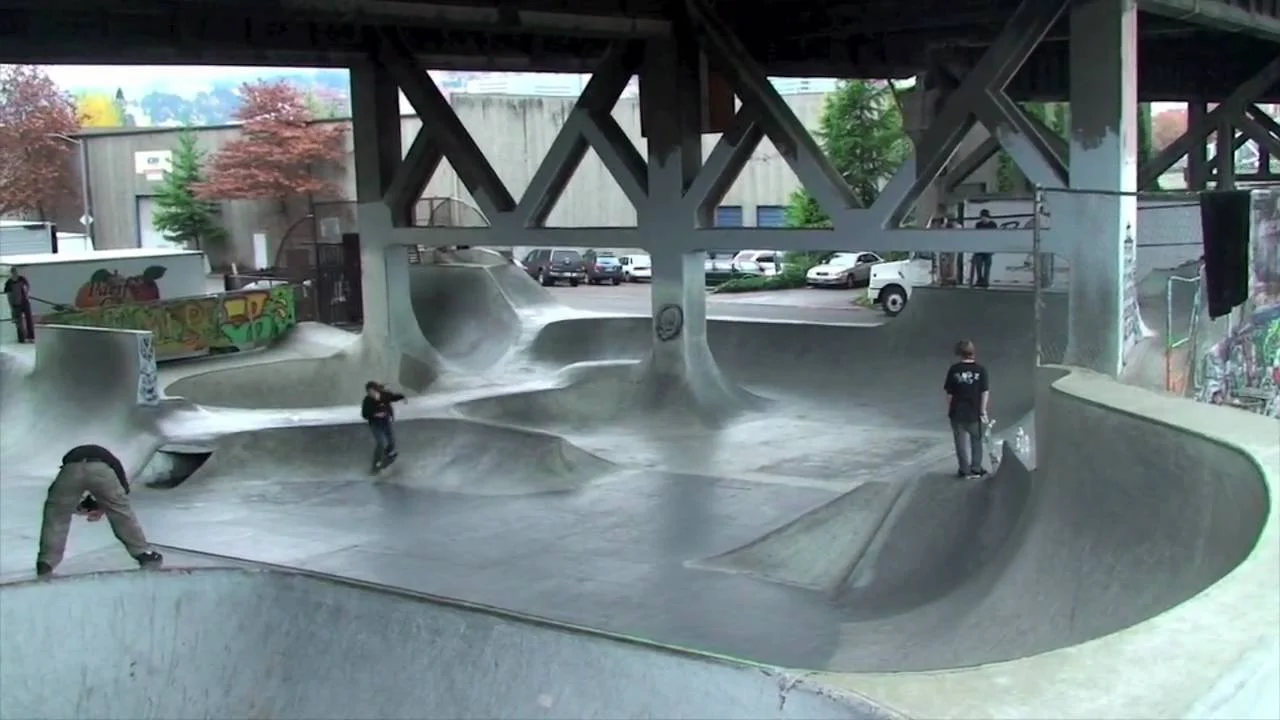
Photo: DaveG.tv
8. The strategy aims to develop new facilities, explore ways in which skating and riding can be used to build and strengthen the community, and promote the city’s skating culture to drive economic development.
9. AND, the plan was developed with ‘extensive community engagement’, including consultations with young people.
10. Cities around the world have learned to blend riding with walk-ways, parkour and jogging paths.
11. The same thing is happening in Palestine, Jordan, Tunisia, South Africa, Addis Ababa, Roskilde, Oslo and Detroit.
12. ‘City authorities are also realising skating’s financial potential, with Louisville, Ohio, Shanghai and George Town, Cayman Islands establishing multimillion dollar skate parks to promote tourism.’
13. ‘Ignoring the economy tied up with skating is negligent.’
14. Why uninvest from skating and riding?
Around the world, skating has a unique ability to help those who feel alienated.
Skating resonates with people because it's fun, challenging, and has the perception of being dangerous.
15. Australian Oliver Percovich founded Skatistan – where he uses skateboarding to help young people in Afghanistan, where ‘there are no created spaces to play’.
16. Youth projects in Afghanistan, Ethiopia, Cambodia, and the UK have used skating and riding to address social issues.
17. Oliver believes that, ‘At the heart of skateboarding is what young people need and want the most – creativeness, risk taking, social connections, enjoyment and an escape’.
18. ‘It’s often argued that the independent, risk-taking and even entrepreneurial characteristics of skateboarding are exactly those which modern society wishes to promote.’
19. ‘It’s about creating something out of nothing. It’s imagination put into action’.
20. Riding is a hands on educational tool. It ties in with art, construction, design, sport and team work skills.
21. City Mag made this cool GIF of a rider teaching a young girl how to prepare a metal railing for a trick.
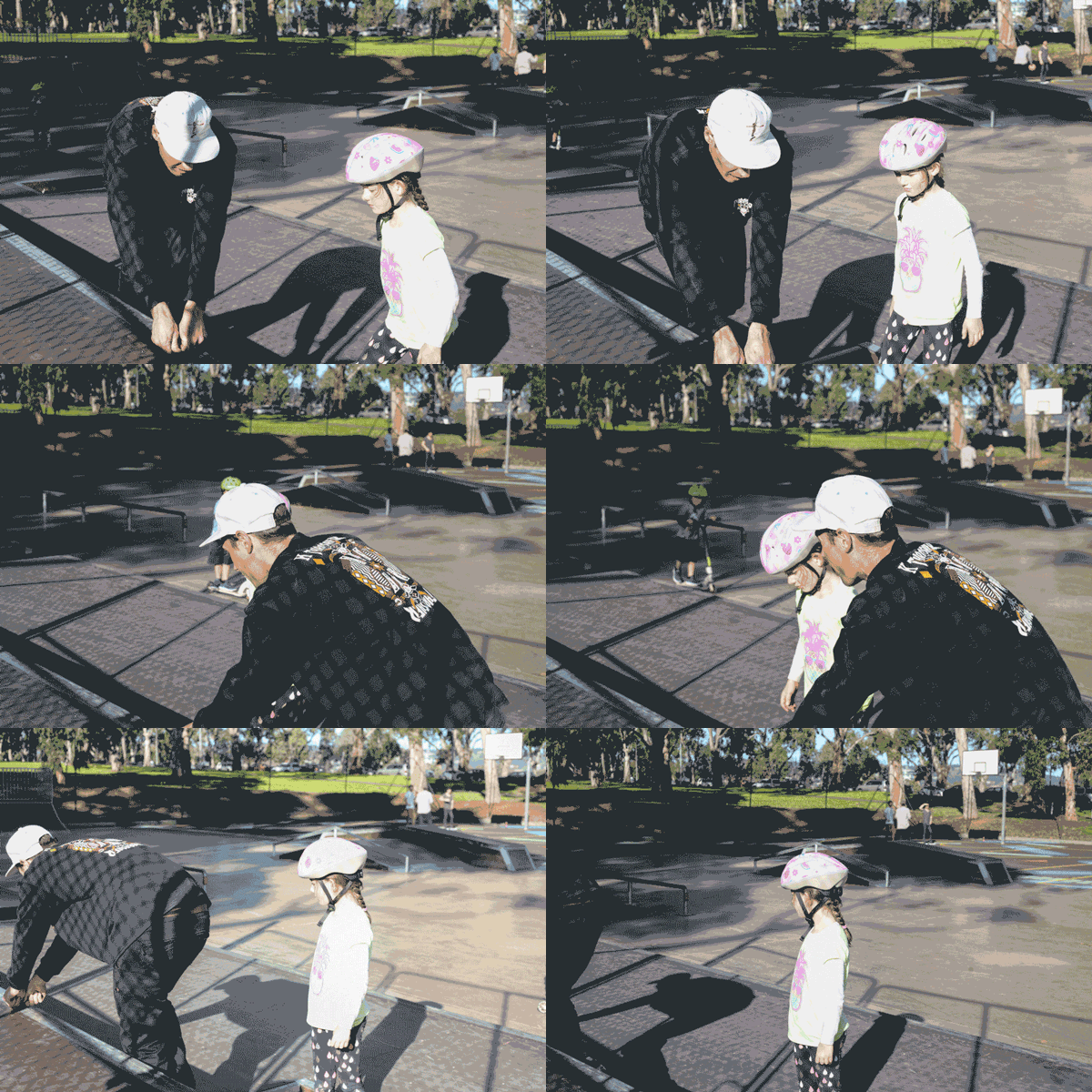
Photo: City Mag
22. At the heart of skating is the idea of sharing knowledge.
Skating is also beginning to gain recognition as a mainstream sport, one that is affordable and non-violent.
23. Riding, as a leisure sport and art form, has matured over the last couple of decades.
24. Riding is one of the few sports we have where the atmosphere is about mutual appreciation, rather than direct rivalry.
25. Riding is way more financially accessible than team sports (especially for young people with low incomes).
26. Unlike other sports, there are no registration costs for riding.
27. Riding is one of those sports-like activities (such as cycling and running, to name but two others) which can benefit both individuals and communities, being both easy to start, and easy to continue.
28. Not to mention that, in 2020, skateboarding will be an Olympic sport.
29. So technically, the temporary skate park is one of the only public Olympic training facilities without access to running water.
To recap:
30. The entire world is investing in riding.
31. And by ‘the entire world’, we mean: Barcelona, Rome, Philadelphia, London, Afghanistan, Ethiopia, Cambodia, Portland, Oslo, Roskilde, Louisville, Ohio, Shanghai, George Town, Caymen Islands, Palestine, Jordan, Tunisia, South Africa, Addis Ababa, Detroit, amongst others.
32. Riding is driving jobs and tourism in major cities around the world.
33. Riding is assisting young people.
34. Riding is an affordable (Olympic) sport.
35. Riding can enhance culture centres.
36. Riding can drive communities.
37. Riding promotes independent, creative, entrepreneurial skills that will benefit young people.
38. For some reason, we are going against all of those trends.
39. We have put young riders on the outskirts of town, in the dark, away from transport, food, toilets and water.
40. Referring back to Matt Hodgson’s comments at the top of this piece:
“ARE WE THE ONLY MAJOR INNER CITY WHERE THEY’VE ACTUALLY DEMOLISHED AN INNER CITY SKATE PARK? IT WOULD BE WEIRD TO TAKE A STEP BACK WHEN EVERYONE ELSE IS MOVING FORWARD.”
WHAT NEXT?
It's all in limbo.
There's a temporary skate park, that has limited access to water, toilets, transport and lighting. The community is asking for a permanent park.
Some have pointed at the Riverbank, the old RAH and the North end of West Terrace as possible sites for a new facility.
What can YACSA do?
We have been working with a group of young people, along with older riders, to develop a plan moving forward.
As the peak body for young people, we are helping the young people understand the advocacy process, and giving them the tools they need to push for change.
Part of that process is the survey below.
What can you do?
Fill out this survey. Share your experiences, your views, your questions, your concerns and your ideas.
Help this group of young people drive change.
Thanks!

Understanding the housing affordability crisis (with videos)
Buckle up as we do everything we can to make housing affordability non-boring and easy to understand (BECAUSE IT'S SUPER IMPORTANT).
We can all agree that talking about economics, taxation and retirement funds is one of the most boring things you can do.
But living in your own home is a pretty cool idea. And whether it’s the cost of buying a home or renting a home, things have gotten pretty ridiculous over the last 10 years.
And it’s going to have a pretty major effect on the lives of young people.
So we scoured every corner of the internet to find INFORMATIVE and SOMEWHAT ENTERTAINING videos that explain exactly what's going on.
By the end of this, you should have a solid understanding about the concepts, issues and debates.
Let’s go.
WELCOME TO YACSA'S GUIDE TO THE HOUSING AFFORDABILITY CRISIS!
A brief introduction:
House prices have spiked in the last 10-20 years
By house prices, we mean the cost of buying OR renting
That means a lot of young people are finding it impossible to find a safe and affordable place to live.
As a response, the government have considered letting young people use their retirement savings (superannuation) to buy their first home.
Economists, the opposition, and even the government have said that's a terrible idea that will hurt young people.
Also, negative gearing is a thing.
OK. Got it?
No? That's OK, this is incredibly complex. But we PROMISE it will make sense after this.
STEP 1 - THE HOUSING AFFORDABILITY CRISIS
Nicole Gurran, one of Australia's leading academics in this space, explains the housing crisis in a more nuanced way:
And Eliza Owen did a TED talk on how to explain to older people that things are way worse off than they’ve ever been, and that telling young people to ‘just save up’ completely misses the point.
STEP 2 - WHAT IS NEGATIVE GEARING
Here’s a quick video from Buzzfeed that uses jelly beans to break down how negative gearing works:
Now that you know how negative gearing works, watch Waleed explain how negative gearing is used, and the link to the affordability crisis:
Basically…
The first (only?) rule of economics is the price is determined by supply and demand.
That means if there was only 1 chocolate bar left in the world, the high demand and low supply would make the cost of that chocolate bar very expensive.
If there were 1 billion toothpaste flavoured chocolate bars, there would (probably) be low demand, and a huge supply, so the cost would be low.
What negative gearing does is it increases the demand for housing - it is an attractive investment so people want to buy more of them.
And because negative gearing increases the demand, it also increases the price.
And prices have gone up faster than wages.
Hence, the theory goes, negative gearing has made our homes more expensive and unaffordable.
And high houses generally lead to higher rental prices.
STEP 3 - USING SUPERANNUATION
So in 2017 the federal government considered allowing young people to access their superannuation to pay for their housing deposit (When buying a home, you normally have to pay roughly 10% up front as a deposit).
Here's a video that somehow explains what superannuation is by using a TARDIS who likes to water plants (you're very welcome):
For those who didn't watch the video, superannuation is:
A mandatory payment of 9.5% of your salary, by your employer, into an investment account, that is managed by someone else so you do not have to think about it, that you can't access until you retire, that is used to fund your retirement.
Very boring
SO IS ALLOWING PEOPLE TO USE SUPERANNUATION TO PAY FOR HOUSING A GOOD IDEA?
Nope.
Saul Eslake explains that this will not solve the housing affordability crisis, and will actually make houses more expensive:
You can read more about why people are saying it would be a bad idea by checking the following links:
The Conversation explain the nuances in their academic-y way.
Buzzfeed explain it in their usual lighthearted yet informative genre.
Whilst The ABC explores the politics involved.
WE'RE DONE!
Congratulations on completing YACSA's introduction to housing affordability.
If we've done our job right, you should now be pretty aware that:
Housing affordability is a massive issue, and we are in the midst of a bona fide crisis.
Things are much, much, much harder than they were 10, 20, 30 and 40 years ago.
The crisis will affect the lives and futures of young people.
Asking young people to use their superannuation on housing is just plain silly.
And if you forgot all that, or you just skipped to the end, here's an image we made that sums it all up:


The police have new powers (and it will affect Schoolies)
Victor Harbor is being declared a Public Precinct this weekend - find out what that means...
Alright, so the main area of Victor Harbor will be a ‘Declared Public Precinct’ for schoolies this weekend.
Let’s try answer the four questions you have on this – What is a declared public precinct, why are they making it a declared public precinct, what space are we talking about, and is this a good thing?
WHAT IS A DECLARED PUBLIC PRECINCT?
So the previous Labor government amended the Summary Offences Act so that certain public spaces could be called “Declared Public Precincts”.
This means that public areas can, for specified time periods, become areas in which you can potentially face increased police scrutiny, fines, removal and barring.
Declared public precincts give the police increased powers, and with ‘reasonable suspicion’ police can use metal detector searches on anyone within a ‘declared public space’ and they can use other search methods if you fail to comply. You can be removed from the area if police believe that you are behaving in a disorderly manner or are a risk to others (you also face a fine of up to $1250) and if you return to that area within a 24 hour period you could be issued a fine of up to $2500.
Also, anyone under the age of 18 (without a responsible adult present) can be removed and either taken back to their homes or can be considered under the guardianship of the Minister if police believe the young person is at risk.
WHY ARE THEY MAKING IT A DECLARED PUBLIC SPACE?
The State Government has declared Victor Harbor a “public precinct” during Schoolies week in a response to:
Crackdown on “Toolies”
Reduce offences, and
Increase public safety
WHAT SPACE WILL BE A 'DECLARED PUBLIC PRECINCT'?
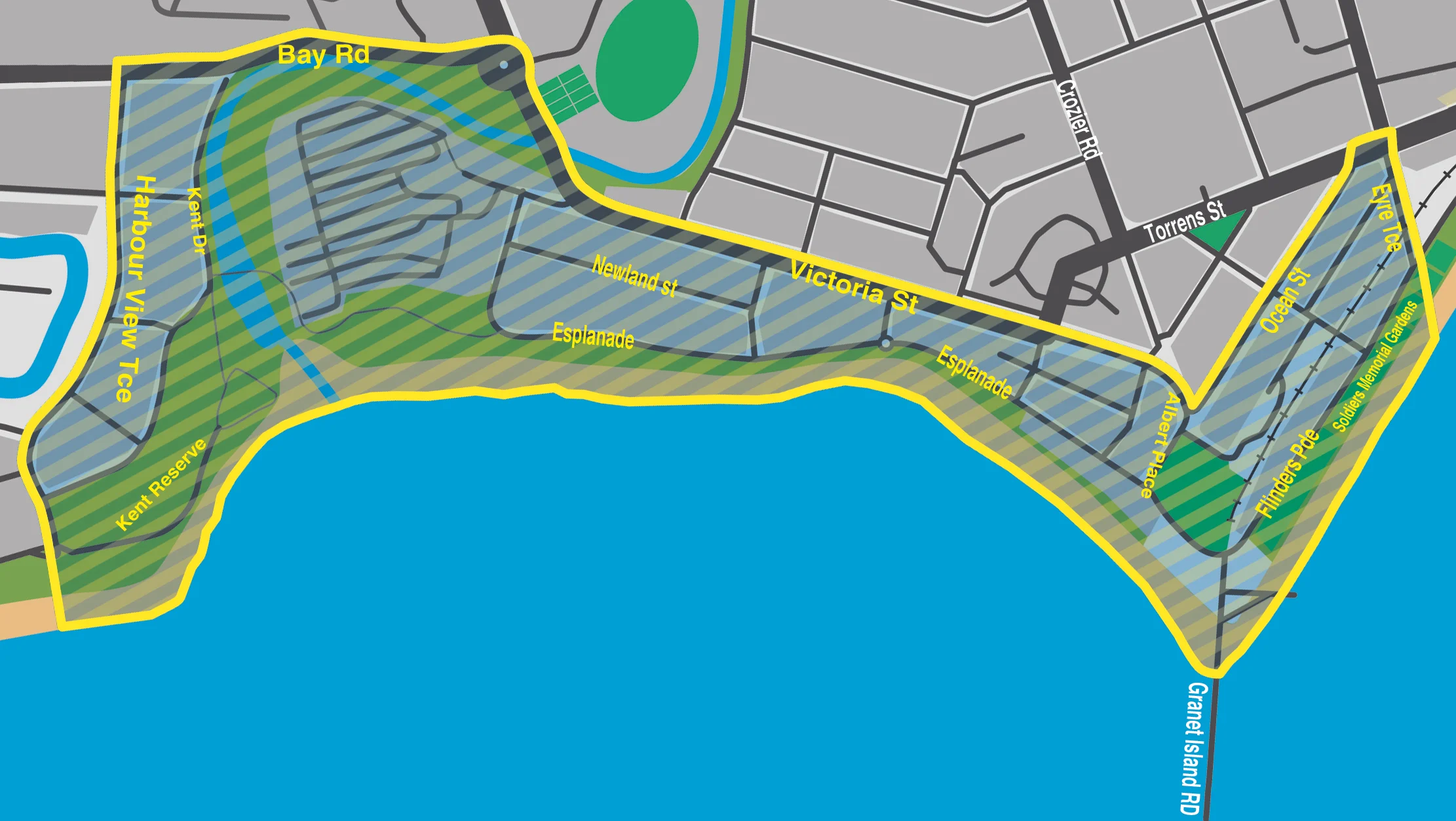
The area covered by the Victor Harbor declaration will cover the borders of Eyre Street, Flinders Parade, the Esplanade, Franklin Parade, Harbour View Terrace, Bay Road, Victoria Street, Albert Place, Ocean Street, Torrens Street. Further information is available here.
The space will be a ‘Declared Public Precinct’ from the hours of 6pm to 3am on Friday, Saturday and Sunday night.
Basically, it's more than the festival zone - it's a pretty big public area. Here's a map of the Declared Public Precinct:
IS IT A GOOD THING?
If you want to know the full scoop on what YACSA thinks about ‘Declared Public Precincts’, check out our submission here.
Here’s an excerpt:
"The use of public space by young people is the subject of almost perpetual debate. With active citizenship and the use of public space being increasingly linked to consumption and financial participation, young people are being progressively excluded from public and commercial spaces and are subjected to increased surveillance, regulation and stigmatisation. Young people are often perceived and promoted (particularly by the media and some business owners) as pests or as a threat to the enjoyment of public spaces by others."
"YACSA contends that young people, (while using public space) are subjected to an increased amount of suspicion, regulation, restrictions and surveillance. Increased regulation for young people accessing public space is often couched in terms such as “crime prevention” or “decreasing anti-social behaviour” - But low crime and anti-social behaviour rates in juvenile populations aren't easily reconciled with this heavy handed approach."
WHAT TO DO
If you’re going to be at schoolies, just be mindful that police have extra powers this weekend.
Click here to find out tips to celebrate safely at Schoolies 2017.
We’ve set up a space at the bottom of the article where you can tell us what you think about the Declared Public Precinct stuff, or you can tell us your experience with the police at schoolies – good or bad.
AND FINALLY
Well done on finishing high school!

Young people paying the penalty
Penalty rates have been cut, and a loooot of young people are feeling it. Check out how/why the decision was made, and how social media is clapping back.
PENALTY RATES HAVE BEEN CUT - CHECK OUT HOW/WHY THE DECISION WAS MADE AND WHAT PEOPLE ARE SAYING ONLINE.
WHAT HAPPENED:
The above video from SBS explains:
- What penalty rates are.
- The cuts that have been made.
- And some of the politics behind the decision.
The decision to cut penalty rates is going to heavily impact people who work in retail, hospitality and fast food.
This is a big deal for young people because young people rely on these industries for employment.
The Conversation tells us:
“This will hit young people the hardest as research tells us that while a third of Australians rely on regular Sunday shifts as part of their wage, nearly 40% of young people rely on penalty rates to survive.
Ultimately, young people are at the coal face of any change to minimum entitlements, and face the greatest risk of losing out at the hands of this reform.”
So let's check in on what the ever-enlightening voice of social media had to say about this issue:
1. PEOPLE TOOK TO TWITTER TO TALK ABOUT WHAT PENALTY RATES MEAN TO THEM:
2. SOME WONDERED IF THE PEOPLE MAKING THE DECISION COULD UNDERSTAND THE IMPORTANCE OF PENALTY RATES:
3. A FEW PEOPLE FOUND THE DECISION BAFFLING:

Source: Australian Unions Twitter
4. IT WAS ALSO POINTED OUT THAT THE DECISION WILL ESPECIALLY IMPACT YOUNG WOMEN:
5. AND A FEW YOUNG PEOPLE GOT INTO THE NITTY GRITTY ECONOMICS OF WHAT IS GOING ON:

Source: Facebook

Source: Facebook

Robo-debt
The robo-debt scandal was about young people being asked to pay back debts they didn’t owe. Find out how the internet responded
One of the hottest politics stories in 2017 (in Australia at least...) was the chaos surrounding the Centrelink debt letter fiasco.
Basically what happened was:
The government used a computer to determine if people had a Centrelink debt.
The computer got the equation horribly wrong.
Young and vulnerable people all over the country received letters demanding they pay back debts that were non-existent.
They made contesting the debt the most painstaking, arduous and monotonous task imaginable.
There have been reports of extreme confusion, distress, depression and even suicidal thoughts from people who have received letters.
The Minster, though, said everything was running smoothly and has refused to shut down the computer (which is sending out 20,000 debt letters a month).
People were not very happy. At all.
This issue affected young people at a really serious level:
Over a quarter of people who are on government income support are young people, which makes sense because young people have a harder time cracking the job market and when they do, are subject to things like casual incomes and youth wage which can limit how much they earn.
The language and nature of the letter confused a lot of young people. There was a story in The Guardian that talked about how young people might not understand the letter and pay the debt without contesting its authenticity.
Young people are less likely to have the savings necessary to pay back a large debt within 21 days.
Thankfully young people (and the internet in general) have a beautiful way of articulating their frustrations, opinions and ideas in the most engaging and simple way possible: memes.
So walk with us as we unpack and uncover some of the best memes (and videos) that were spread across the internet in the wake of the attempt the debt-onate young people.
If crude satire is your thing, this video explains breaks down the Centrelink ridiculousness in a simple but punchy way (note: this video uses swear words).
First Dog On The Moon seemed to think that this crackdown was so malicious that the painful ramifications may have been deliberate (click here for the full comic strip):
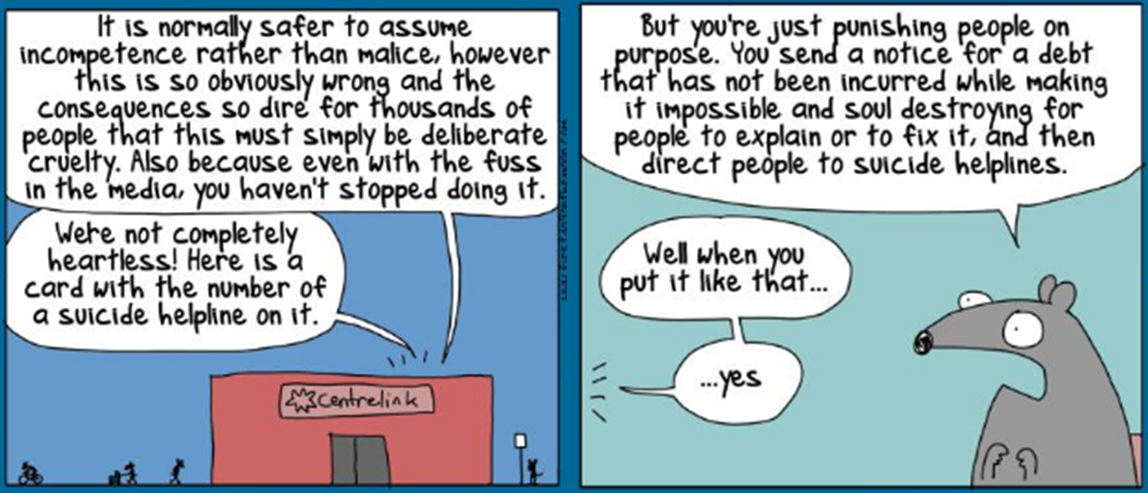
Source: The Guardian
Australian Political Memes hyperbolated just how mean-hearted it was to ask the poorest people to fix the Government’s debt crisis:
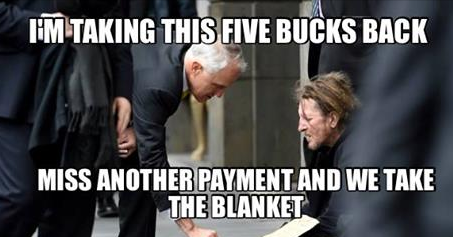
Costa A tried to make sense of why the Government might target vulnerable people:
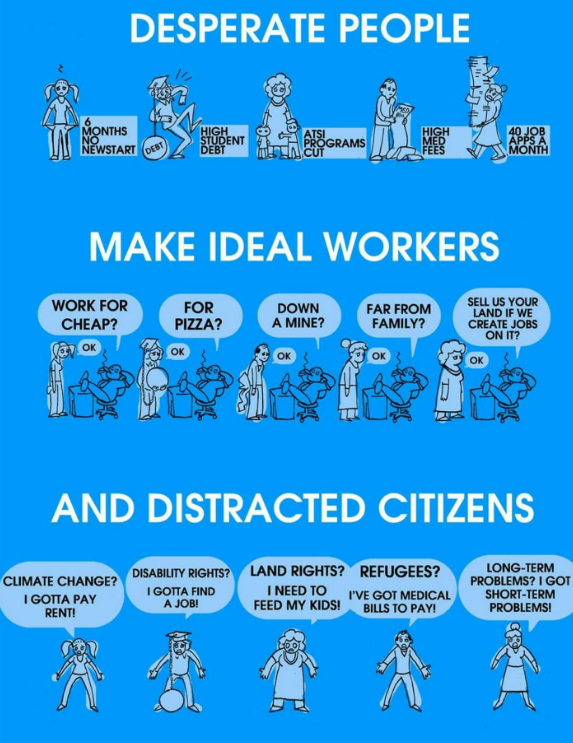
Source: Costa A Comics
Just as there are many stages of grief, there are many stages of disbelief, particularly in the swift paced online world.
When Sussan Ley (a politician) was found to used her parliamentary entitlements to claim a private, chartered plane to the Gold Coast, where she conducted private business, people smelt hypocrisy.
The question on the minds of people across the internet was simply; how can the government tell us to pull up our socks when they spend taxpayer money so lavishly on themselves?
Some blamed the morals (and moreso, the culture) of Parliament:
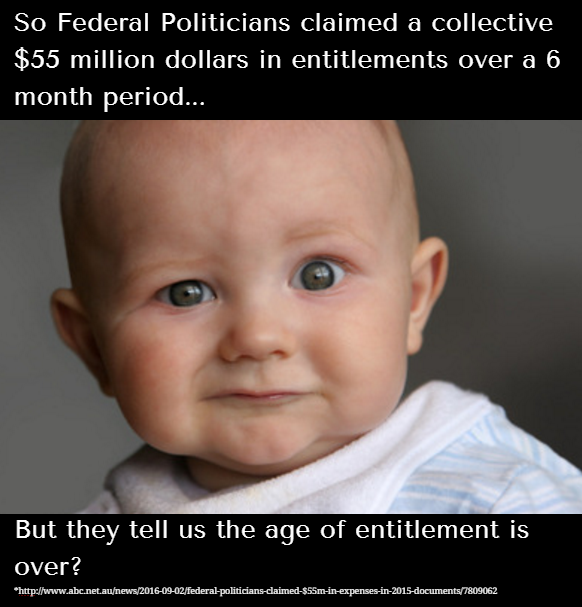


Some parliamentarians came to the defence of Ley, saying she had not broken any rules.
.. To which the internet responded:

Australian Political Memes gave a great conclusion to this whole hypocritical entitlement fiasco:

Our take aways in all of this are simply:
This attack on young people, and vulnerable people across Australia, was pretty uncalled for.
The public should be concerned over the way governments treat and target young people.

Sick of young people being blamed for being poor? Use this.
We’ve got the facts and stats to bust that myth.
How often do you hear throw-away comments like:
- Young People should just get jobs
- Young people are careless with their money
- Young People are just lazy bludgers.
Well, not only are these sorts of comments destructive and divisive, they're also just plain wrong.
In light of Anti-Poverty week, YACSA dug up some research on systemic and social factors that make it more difficult for young people to escape poverty than ever before.
Here's what we've got. Feel free to use it.

(For a downloadable PDF version of this graphic, with each fact hyperlinked to its source, click this link)