
YACSA's Election Day Guide
Where do you vote? What do you bring? How do you fill in the ballot paper? What's a democracy sausage? We've got the answers.
Where do you vote? What do you bring? How do you fill in the ballot paper? What's a democracy sausage? We've got the answers.
THE 6 STEP ELECTION DAY GUIDE.
From the moment you arrive, until the moment you leave, here's what to expect and what to do.
Step 1: Preparation
Firstly - have you enrolled to vote? Click here to make sure you're enrolled to vote.
WHERE CAN I VOTE?
You can vote at any 'polling booth'.
The easiest and quickest way to vote is to go to a polling booth within the electorate you are voting in.
If you are not going to be in your electorate, in South Australia, or even if you’re going to be overseas for the election, or if you won't be able to get to a polling booth, click here to find out about postal voting.
WHAT DO I BRING?
All you need to bring is yourself!
Step 2: 'How to Vote' forms
The moment you arrive, there will be a bunch of people handing you 'how to vote cards'.
These are recommendations from the parties on how they would like you to vote.
They are NOT mandatory.
Feel free to refuse to take them.
Feel free to use them.
Feel free to recycle them.
Feel free to fold them into unique pieces of origami.
But you don't HAVE to do anything with them.
Bonus YACSA tip:
'How to vote' cards make fantastic paper aeroplanes.
Step 3: Queuing
You will enter a queue.
The queue might be very long.
Brace yourself.
Bonus YACSA tip:
We recommend sharing Smashed Avocado stories with people around you to pass the time.
Step 4: Ticking your name off
You will walk up to the official person at the desk.
They will find you on the electoral roll and cross off your name, give you your ballot papers, and send you on your way to a small, cardboard voting booth.
Bonus YACSA tip:
There's thousands of people in their book. It might take them a while to find your name. They've had a long day. Be nice to the election officials.
Step 5: Actually voting
For now, here are the basics:
For the GREEN ballot paper:
Put a '1' in the box next to your favourite candidate.
Put a '2' next to your second choice.
Keep going down until EVERY BOX IS NUMBERED.
Note: you can also go reverse, and put the lowest number possible for your least favourite candidate and work your way up.
You can find a practice green ballot here.
For the WHITE ballot paper:
Same as above, in that you put a '1' next to your favourite candidate, a '2' for your second favourite, and so on.
If you vote 'below the line', you need to mark at least 12 boxes.
If you vote 'above the line', you need to number at least six boxes from 1 to 6.
However, with both, you are free to mark as many more as you like.
You can find a practice white ballot here.
If you make a mistake, you can always ask the official for a new sheet.
When you're done, take your ballot papers and put them in the fancy looking box.
Bonus YACSA tip:
Skip the graffiti on your ballot papers, while you’re allowed to it ultimately just makes the election officials job harder when they’re counting votes. There are waaaaaay better ways to express your political views or frustrations - like becoming a YACSA young member! (click here to sign up!)
Step 6: Reward yourself
Well done! You have just democracy-ed. (Yes, we made that word up).

It's time to celebrate.
We recommend grabbing a democracy sausage before you leave (or a gluten free/vegan alternative).
The democracy sausage is a time honoured tradition unique to Australian democracy, where the local sausage sizzle is a vital part of the voting experience - and it helps raise money for the local school/community group.

Polls: What do they mean and can we trust them?
It’s officially election season so there’s polls everywhere - but what do they mean? And can we trust them?
Polls are a staple of election season, whether they’re asking who your preferred party or leader is, a lot of election coverage will include polls to gauge public opinion.
What’s a poll? Sometimes also called an ‘opinion poll’ it’s essentially a survey of a group of people to find out what they think about election-related issues. This could be to find out what local issues are important to them, how they view the government, opposition or parties or which candidates they’re likely to vote for.
But elections often prove polling can be a far cry from the public’s voting intentions. Outlets can also paint a skewed picture of the data they’re reporting from.
The below graphic from The Australian was widely circulated, not for the results, but the representation of them.
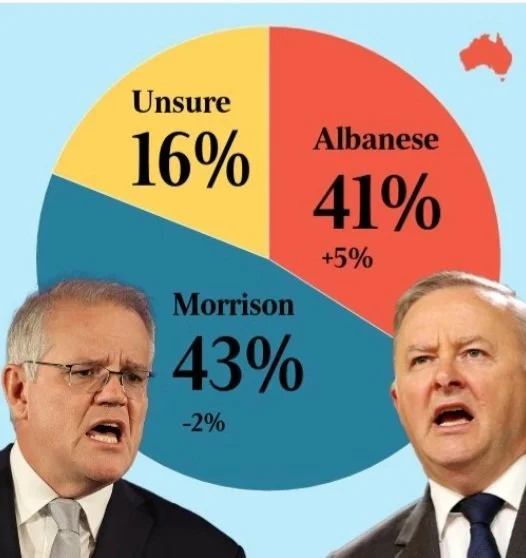
Polling graphic published by The Australian in the lead up to the 2022 Federal Election.
It’s not shocking that this made waves, one of the largest media outlets in the country somehow cleared this to be published. Twitter and other social media platforms blew up, confused by how 41% could possibly be so much smaller than 43%.
But unequal pie charts aside, should we give polls any real weight?
The answer is yes and no.
Polls can be a good way to get a picture of public opinion, particularly because media attention doesn’t always reflect the views of the public.
But it’s important to remember they will always have a margin of error, which is generally around 3%.
That means is that if 52% of people polled responded to one option the real figure is anywhere from 49–55%.
It’s a consideration we have to make for whoever is polling lower too.
48% with a 3% margin of error means the real figure could be anywhere from 51-45%, and while that’s still a lower range than their hypothetical opponent, there’s a lot of overlap, and it isn’t really enough to make a concrete call on an election.
Because of this, changes or ‘swings’ of a few per cent probably don’t measure up to any real change in public opinion. The 2019 federal election is a perfect example of this. Polls were reporting 52-48 and 51-49 in favour of Labor calling it an election they couldn’t lose and, as it turns out, that wasn’t the case.
The media will report on almost any change now that we’re really in election mode, so we’re left to look past the headlines. Is every reported ‘shocking’ poll result going to be as surprising or as important as it claims? It’s unlikely, so our attention is better directed toward the actual numbers, rather than the sensationalised headlines.
While polling isn’t an exact science, data collected over months and years can illustrate trends in public opinion. Rather than just looking at the most recent results or disregarding them all together, direct your attention to any trends they may highlight.
One set of polling numbers on their own really don’t tell us much, but we can look at where they sit in comparison to past polls. Is one party’s number going up over time? Are the polls coming back around the same each time? The more data we can look at and the more media news we can cut through the better.
Enrolling to vote
Enrolling to vote can be confusing, so we put all the information in one place.
Please note: enrollment for the 2026 South Australian state and First Nations Voice to Parliament elections will close at 5pm on Friday 27 February.
Some key things to know:
Enrolment for state and federal elections is managed by the Australian Electoral Commission
If you have enroled for previous elections (this could be a state or federal election, or referendum), you don't need to enrol again.
If you've already enroled, it doesn't hurt to check your details to make sure they are correct.
If any of your details are incorrect (like if you’ve moved house), make sure to update them.
To verify your identity when enrolling you will need one of the following: Australian driver license number, Australian passport number, Medicare card details, Australian citizenship number or someone who is currently enrolled confirm your identity.
You can enrol to vote if you are 16 or 17, but you can only vote if you are 18.
Can young people change the outcomes of elections?
Spoiler alert: absolutely you can
Each time an election comes around there’s a pretty good chance you’ll hear at least one person express that they don’t think their vote really matters. It’s not hard to feel disenfranchised by parties and government, particularly as a young person but your vote has the power to elect someone who you believe will represent you better.
Let’s look at the marginal seats going into the 2022 State Election as an example.
There were six marginal seats heading into the state election. These are seats that were won in the 2018 election by a small percentage of votes, often less votes than there are eligible non-voting young people in that electorate.
In the 2018 election the electorate of Newland, previously a Labor party seat, was won by Liberal Richard Harvey by only 27 votes, or 0.1% of the votes in that electorate. But Newland had an estimated 501 non-voting 18-24 year olds, more than enough votes to decide which way that seat could go.
Below are the six marginal electorates, the margin and the estimated number of non-voting 18-24 year olds in that electorate - in table and Tik Tok form:
